The Rule That Holds Teton County's Property Tax Down
Idaho's property tax cap freezes every taxing district at its base-year size. It's why Teton County's budget stays small as the valley fills with houses.
DRIGGS — Teton County's three commissioners spent June 23 closing a $130,000 hole in next year's budget, trimming and shifting the few lines they are allowed to touch. Idaho's property tax cap left them no room to raise the money: a 1995 law holds the growth in a county's collections to about three percent a year, even as assessed values double.
The law applies the same formula to every taxing district, then fixes each one at the size it was when the property tax cap took effect. Teton County was small then, and its budget has stayed small ever since, even as the valley around it became one of the fastest-growing places in Idaho. The county has money. Its problem is the ceiling on collecting more, and Idaho law leaves few ways around it.
The three percent rule
Idaho caps how much any taxing district can grow the property taxes it collects from one year to the next: no more than three percent, plus a measured amount for new construction. The limit binds the budget, the total dollars a district collects. It leaves the tax rate and a home's assessed value alone.
The three percent grows from the highest property-tax total the county certified in any of the previous three years. The county may add the taxes a new house generates on top of that, but only at the existing tax rate, applied to ninety percent of the home's value. So assessed values across the valley can double while the county still collects about three percent more. New construction adds dollars without raising the cap, and as values climb, the rate charged on each parcel falls.
Because the cap is figured from the highest of those three years, a district that collects less than the law allows loses the difference. Its base resets down to what it took, and the next year's three percent compounds from that smaller number. A district can preserve the unused room only by setting it aside as "forgone," which takes a resolution, and tapping it in a later year takes its own notice and public hearing. A district protects its base only by certifying the most it can each year, whether or not the budget needs the money.
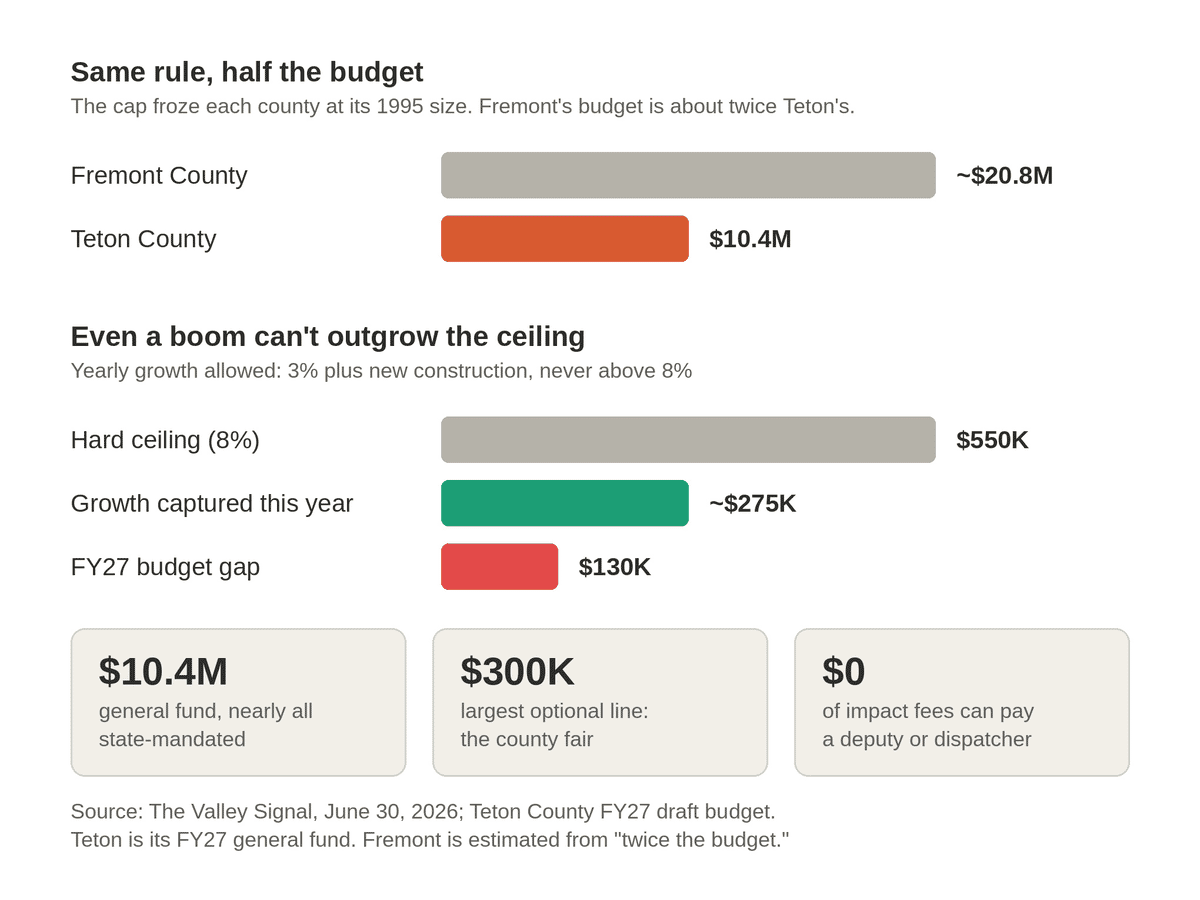
The whole annual increase, the three percent plus new construction plus any annexation, can never exceed eight percent. "8% would be $550,000," county clerk Kim Keeley told the board June 23, roughly twice the growth the county captured this year, and "once it gets to 8% cap, it's done." Even a building boom, even growth at twelve percent, can't push the budget past it. "The notion that we want to increase our tax base," she said, "it doesn't play out."
The three percent is the old part, enacted in 1995. The harder limits came later: a 2021 law, House Bill 389, added the eight percent ceiling and trimmed the credit for new construction to ninety percent of its value. The same law raised the homeowner's exemption to a flat $125,000.
So far, the caps all apply to the dollars the county collects. Idaho sets one more on the rate itself, and it never comes into play locally. The state holds the current-expense levy rate to a fraction of a percent of market value, and the rate Teton County sets falls far below that ceiling. "We're nowhere near the levy cap," Keeley explained, "because our values are so high. Our levy rates are way below the levy caps." The rate cap stays slack, so the three percent on the budget is the only limit that binds.
Every taxing district in Idaho budgets within that same property tax cap. Driggs, Victor, and Tetonia each live under the same three percent, and so do the school, fire, library, and cemetery districts that share the tax bill. The rule does not treat them alike. The three percent rides whatever base a district was already collecting when the cap took hold 31 years ago, and it has ridden that number ever since. A government that was large then stayed large; one that was small then stays small, however fast the ground underneath it fills with houses.
Commissioner Dan Powers pointed to Fremont County, to its north, "similar population," he said, but with "twice the budget," because "when they instituted the 3% cap, their budget was twice as high as ours." The three percent has compounded on both budgets ever since. New construction adds to that, but only at each county's existing levy rate. Held down by its sky-high values, Teton's rate is so low that even rapid building has done little to close the distance. It shows up in what the two counties pay their people. Powers noted that Fremont's elected officials "do well," while several of Teton County's, by the board's own count that afternoon, rank among the dozen worst-paid in the state. The reason, Powers said, is the same one: "We just started from this low level" when the cap came in. The same rule produced half the budget, decided by where each county stood the year the limit began.
A mostly mandated budget
The obvious answer on a tight budget is to cut, but Teton County doesn't have much room to do so.
Almost everything in its operating budget is a service the state requires it to provide. The general fund runs about $10.4 million in the clerk's FY27 draft, nearly all of it mandatory: a sheriff's office, the courts, a prosecutor, the cost of jailing the people it arrests, and the offices that assess property, collect taxes, run elections, and investigate deaths. Most of it is salaries: the deputies, dispatchers, and clerks the county has to pay. The county can trim at the edges, but cannot cut mandated services.
The county's own discretionary spending is small by comparison. Its largest optional line, the county fair, runs about $300,000, with a handful of outside contributions beyond that. The parks district, the library, and the fire district run on their own levies, outside the county budget. Each is a separate taxing district, with its own elected board and its own line on the tax bill.
The sheriff's office is the only law enforcement in the county, and Idaho law makes patrolling the cities its job, too. None of the towns runs its own force. They pay the county modest sums for extra coverage, and the county has begun pressing the cities to pay a larger share. At about $2.4 million in the FY27 draft, the sheriff's office is the single biggest line in the general fund, and the county wants it bigger: it has been working to fill out the sheriff's roster. No law requires that spending. The commissioners could cut the office, but a smaller force would thin the only coverage the valley has.
The county shed one mandate in 2024, when Idaho took over the cost of public defense statewide. The relief came from the state, not the county. Its other mandated costs stay fixed.
Three taxes off the table
Unable to cut, the county looks for ways to make growth pay for its operating budget. It finds none.
The county can't impose a higher tax on second homes or short-term rentals. Idaho's constitution requires a uniform rate for all property in a county, so the county can't charge a part-time owner more than a full-time one. The rule protects owners who pay the county's taxes but can't vote in its elections, keeping the county from shifting more of the burden onto them. The homeowner's exemption is the one mechanism that shifts the burden, lowering the taxable value of a primary residence. The state sets and caps it in Boise, and the county can't raise it or write a local version.
The county can't levy a local sales tax. Driggs and Victor can ask their voters for one because they qualify as resort cities. Counties don't qualify, so the option that helps the towns capture tourist spending is closed to the county around them.
The county can't reach for a special levy to cover a big one-time bill. When the county settled the Teton Creek Resort land-use lawsuit this spring for $3 million, $2 million of it in cash and the rest a credit against future county fees, it drew the cash from savings. Idaho allows a county to tax outside the cap to pay a court judgment only when the judgment is for personal injury or similar harm. A development dispute doesn't qualify. That limit is deliberate: it reserves off-cap taxing for the kind of judgment a county can't plan around, and makes it pay for its own policy and land-use fights out of the budget and savings it already holds.
Impact fees, at the legal limit
The county controls one lever, and has already pulled it as far as the law allows. New construction pays impact fees. In 2023, the county threw out a flat $2,006 charge that applied to any new home regardless of size and replaced it with a schedule pegged to square footage, the most its own consultants said the law could support. The county assesses it when a building permit is pulled, and the fee follows floor area and nothing else, not what the home is worth, not what the space is used for. An average new house of 2,500 to 2,999 square feet owes the county about $7,100, and the fee climbs with size to a $10,061 ceiling for homes above 8,000 square feet. A separate Teton County Fire District impact fee may apply the same way, on top.
But impact fees carry a wall built into state law. They can pay only for capital, the things growth requires: a road, a pathway, a building, a set of dispatch consoles. They cannot pay for operations, the people: a deputy, a dispatcher, a night of housing an inmate. The wall runs both ways: it also keeps a county from billing new homebuyers for the ongoing cost of government, charging them only for the capital expenditures their houses require. Growth can be made to buy the equipment. It cannot be made to staff it.
The county's 911 center is short-staffed. Its dispatchers earn $24.96 an hour, and hiring two more would cost around $150,000 a year, but the impact fees that will help fund the center's new console system can't cover the salaries of the people who would operate it. At the June meeting, the county discussed asking the fire district to chip in. The fire district is a separate government with its own budget, and the county can't move that money. It can only ask.
What the cap leaves
Every option runs into the same arithmetic. Growth can fund the county's buildings and almost none of its people. The impact fees are maxed out; the property tax cap is fixed by state law; and the homeowner's exemption belongs to Boise. The highest cost is the sheriff's office, a level of policing the county chooses, and the cities pay little toward. That leaves the county two ways to find money the cap won't give it: ask the voters to lift the base, or spend down the reserves it is sitting on.
Sources
- Teton County Board of County Commissioners FY27 Budget Work Session, June 23, 2026
- Teton County Title 15, Development Impact Fee Ordinance and Fee Schedule (2023)
- Teton County FY27 Draft Budget Summary
- Teton County FY27 Personnel Request, Dispatch Positions
- Teton County 2026 Assessment Notice
- Idaho Code § 63-802
- Idaho Code § 63-805
- Idaho Code § 63-602G
- Idaho House Bill 389 (2021)
- Idaho State Tax Commission, Property Tax Budget Limitations (EPB00107)
Subscribe
The Morning Signal
Teton Valley news, once or twice a week. The reporting is airtight. The introduction is unhinged.