Teton County, Idaho Collects One of the State's Smallest Federal-Lands Payments
The Teton County PILT payment totals $341,718, one of Idaho's smallest federal-lands payments and less than a seventh of what Teton County, Wyoming drew.
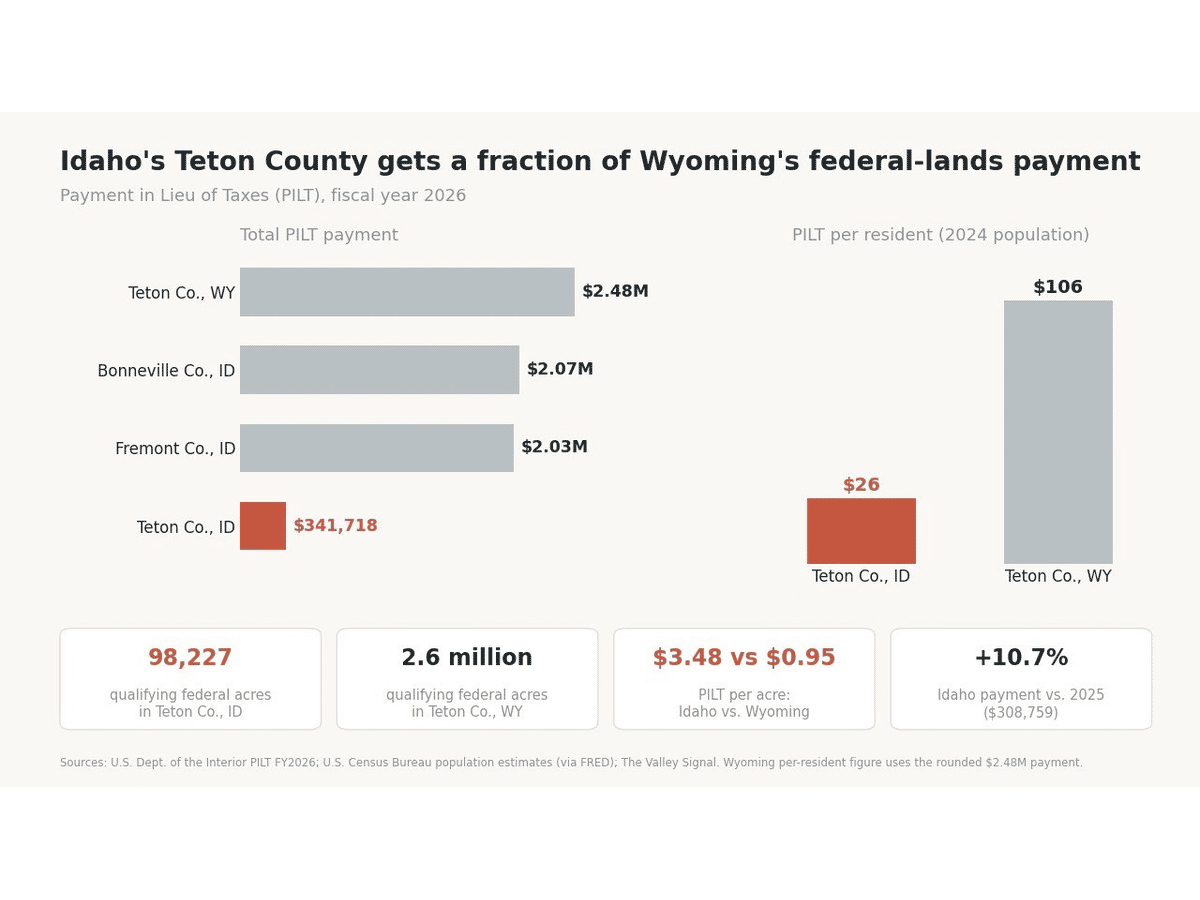
DRIGGS — Teton County, Idaho collected $341,718 this year in Payment in Lieu of Taxes, or PILT, the federal program that reimburses local governments for the untaxable public land inside their borders. The Teton County PILT payment is one of the smallest of any county in the state, less than a seventh of what Teton County, Wyoming received for the same reason.
The U.S. Department of the Interior distributed $49.6 million through the program to Idaho's 44 counties for the 2026 fiscal year, money meant to offset the property taxes counties cannot charge on national forest, Bureau of Land Management ground, and other federal holdings. Teton County ranked near the bottom of that list. Only nine Idaho counties received less.
The Teton County PILT payment is up from $308,759 a year earlier, a 10.7 percent rise on unchanged acreage. The Interior Department attributes part of the national increase to the lapse of the Secure Rural Schools program, which shrank the other federal payments subtracted from the PILT formula.
The payment comes as the county presses a broader argument that it absorbs the costs of nearby federal land and a Wyoming ski resort while the revenue lands somewhere else.
A small slice of federal land
The payment rises and falls with one number, the acres of federal land a county contains. Teton County holds 98,227 that qualify. Nearly all of it, 88,977 acres, is the Idaho slope of the Caribou-Targhee National Forest, with a small amount of BLM and Bureau of Reclamation ground making up the rest. The county has no national park land and no wildlife refuge.
Its neighbors hold far more of that land. Bonneville County, to the west, has 595,752 qualifying acres and collected $2.07 million. Fremont County, to the north, 702,168 and $2.03 million. Teton County, Wyoming, 2.6 million, 27 times the Idaho county's total, and $2.48 million. Grand Teton National Park and the Bridger-Teton National Forest fall inside its lines, along with a corner of Yellowstone.
Much of the high country east of the valley, the Teton Range and the national forest on its slopes, sits on the Wyoming side of the state line. Teton County, Idaho receives no PILT for any of it.
The per-acre twist
An Idaho acre draws more PILT than a Wyoming one. The difference between the two counties is quantity.
Congress sets the payment as the greater of two per-acre rates, capped by a limit tied to population. For 2026 the higher rate is $3.55 an acre, reduced by certain other federal payments a county already receives; the lower rate is 51 cents an acre with no reduction. The cap limits counties that carry vast federal acreage but have few residents to serve.
Teton County, Idaho draws the top rate, $3.48 an acre after its small reduction, the same band as Ada and Bonneville counties. Teton County, Wyoming collects 95 cents an acre. With 2.6 million acres and a small population, it runs up against the population cap. Idaho's Teton, with 98,227 acres, stays far below it.
Unlike local property taxes, which each county sets through its own levy, the per-acre PILT rate is one federal formula. An acre of national forest counts the same in Idaho as in Wyoming. A county's payment depends on how many acres it holds and how many residents it spreads the money across.
Where the check lands
By federal law, the payment goes to the county and can be spent on any governmental purpose. It carries no earmark for the fire district, the ambulance service, or the schools, though those are among the services a rural county stretches to cover across its federal acreage.
Nor is the county required to share it. A state can pass its own law sending part of a county's PILT down to its cities and towns, but only Wisconsin has done so, and even that kind of law reaches general-purpose governments, not special districts like a fire district. In Idaho, the county keeps all of it, and Teton County's commissioners decide where the $341,718 goes.
Idaho counties cannot levy a sales or lodging tax, and a state cap holds their property-tax growth to 3 percent a year. That leaves federal payments like PILT among the few revenue sources a county has.
One more line in the same ledger
Teton County is already fighting that imbalance on another front. It is drafting a formal objection to the Grand Targhee Resort expansion, arguing that the resort sits in Wyoming while the workers who staff it live in Idaho and strain its housing, roads, and emergency services. A 2022 study the county commissioned found it captures no direct tax from an overnight Targhee visitor, while Teton County, Wyoming captures $11.37. The two counties are co-funding an interstate workshop this summer to work out who pays for the growth.
PILT is a separate mechanism. It pays for the presence of federal land, not for tourism, and Wyoming's larger check reflects its far larger federal footprint. But it runs the same direction as the county's ledger. The public-land value to the east sits in Wyoming, and Idaho holds the smaller share.
What to watch: The county's objection to the Grand Targhee expansion is due to the Forest Service by July 13. The interstate workshop with Teton County, Wyoming is set for July 23, with a written summary due to both county boards by the end of August.
Sources
- U.S. DOI PILT, Idaho County Payments FY2026
- U.S. DOI PILT, Idaho Entitlement Acres by Agency FY2026
- U.S. DOI PILT, Wyoming County Payments FY2026
- U.S. DOI PILT, Idaho County Payments FY2025
- 31 U.S.C. §6902
- 31 U.S.C. §6903
- 31 U.S.C. §6907
- DOI PILT FAQ
- Interstate Workshop Catalyzed by Targhee Expansion Set for July
- Teton County, Idaho Drafts an Objection to the Grand Targhee Expansion Over Local Costs
- The Rule That Holds Teton County's Property Tax Down
Subscribe
The Morning Signal
Teton Valley news, once or twice a week. The reporting is airtight. The introduction is unhinged.