An Independent Audit Said Driggs Overcharged Victor on Their Wastewater Loan
An independent CPA examination found Driggs overcharged Victor for years on their shared wastewater loan, the core of Victor's 2026 lawsuit.
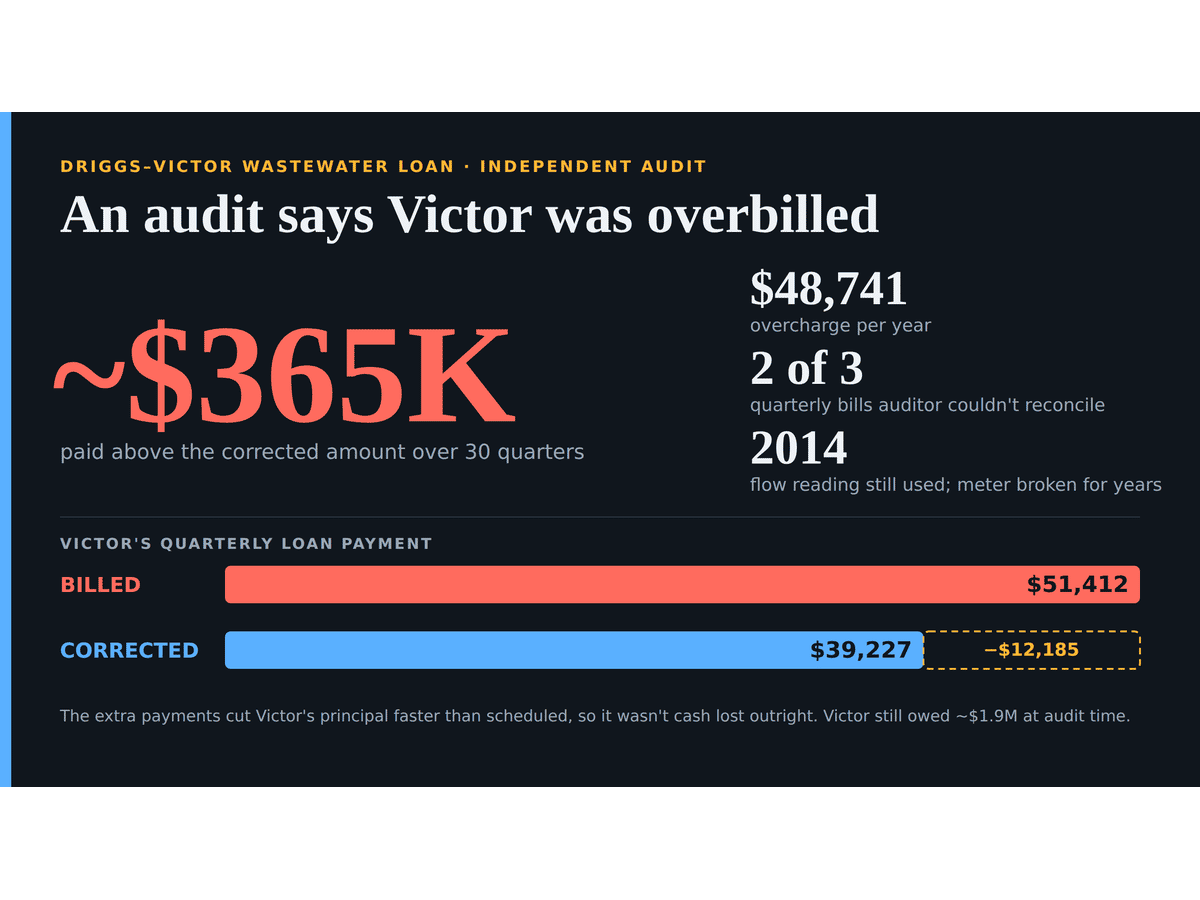
An independent CPA examination jointly commissioned by Driggs and Victor concluded that Driggs overcharged Victor for years on the cities' shared wastewater loan, used a cost-allocation method the inter-city agreement does not authorize, and could not reconcile two of three quarterly bills the auditor tested. The report, signed by Cooper Norman in Idaho Falls on February 9, 2024, became part of the public record on March 27, 2025, when the Victor City Council voted to end the 26-year partnership and build its own treatment plant.
The finding that Driggs overcharged Victor is the documentary core of the breach-of-contract claims Victor filed in March 2026, set down two years before the suit.
What the examination tested
Driggs and Victor share a wastewater treatment plant under a 2011 Inter-City Agreement that requires the cities to split debt service on a 2016 Idaho Department of Environmental Quality (DEQ) loan and to share operating costs. The two cities jointly retained Cooper Norman to test compliance with both. The firm released to both mayors an "amended and restated" examination after Victor asked for additional detail on how the quarterly debt payments split between the wastewater plant and the trunkline.
The original DEQ award, accepted August 18, 2011, came to $1,141,417 for trunkline work, and DEQ rolled it into a larger loan estimated at $10.5 million for the joint wastewater plant rebuild. Driggs is the official borrower and routes all loan payments to DEQ; Victor reimburses its share.
Four adjustments
The examination tested Driggs's 2015 spreadsheet, which had set Victor's quarterly billing for the next 20 years, against the actual loan ledger and engineering documents. It identified four adjustments.
Driggs's 2015 estimate overstated the total loan by $26,513. It used $10.5 million; actual disbursements through June 2016, per the DEQ loan ledger, totaled $10,473,487.
The same estimate overstated loan forgiveness by $6,389. It calculated forgiveness at $2,527,640. The actual forgiveness, per a June 2016 DEQ letter to Driggs, was $2,521,251. Net principal: $7,952,236.
Driggs's 2015 breakdown overstated trunkline costs by $232,948. It allocated $1,413,543 to the trunkline. The actual cost, per the August 2012 Sunrise Engineering construction order and a December 2023 Sunrise allocation breakdown, was $1,180,594.65.
The trunkline split did not follow the agreement. Section 5 of the Inter-City Agreement says the trunkline cost should be divided by the "equivalent residential units" each city has connected, or, if the cities can't agree on that, by a measurement of the actual flow. The cities never determined the unit counts. The auditor recalculated the split the only way the agreement left open: by flow.
The meter had been broken for years
Under the agreement, the cities are to keep that flow measurement current, measuring actual flow and recalculating the split as the numbers change. That has not happened. The examination found the meter at the Major Collection Point "has been inoperable for the past several years and all payment calculations have been made based on the 2014 flow calculation." The split has run on that single 2014 reading, 55.9% Driggs and 44.1% Victor, ever since. The auditor used it too; it was the only flow data anyone had. The report's first formal recommendation was to replace or repair the meter and recalculate the flow ratio at least annually. That was February 2024; whether the meter has since been fixed is not in the record.
Two of three bills could not be reconciled
The auditor pulled three quarterly billings related to operating expenses, covering Q3 2022 through Q1 2023, and tried to tie the totals back to the supporting documentation Driggs provided. It "was not able to reconcile all the billed amounts back to the submitted support for two of the three quarters." The second formal recommendation: reconcile the quarterly billings between the cities and resolve discrepancies on a quarterly basis.
What the examination says Victor owes
Applying the four adjustments and the 2014 flow share, the auditor recalculated what Victor owes. Of the $7,952,236 net principal, 88.7% traces to the wastewater plant and 11.3% to the trunkline. Victor's share comes to $3,108,757 on the plant and $394,945 on the trunkline, a total of $3,503,702 over the 20-year loan.
To set Victor's corrected quarterly payment, Cooper Norman did not divide that total across all 80 quarters. It worked from where the loan stood: a $1,961,342 balance after the December 2023 payment, with 50 quarterly payments left. That comes to $39,226.85 a quarter going forward, or $156,907 a year. Victor had been paying $51,412 a quarter, $205,648 a year.
By the examination's accounting, Driggs overcharged Victor by $48,741 a year. The auditor also identified $7,528.84 in trunkline overpayment, which it credited against Victor's plant balance after the December 2023 payment. Counting the 30 quarters Victor paid the higher amount, the cumulative overpayment comes to about $365,000. Beginning with the Q1 2024 payment, Driggs billed Victor the corrected $39,226.85, ending the overcharge going forward.
That cumulative figure deserves a caveat. The DEQ note is a loan, not a service fee, and the overpayment reduced Victor's principal balance faster than the schedule required. As of the audit, Victor still owed Driggs $1.9 million on the loan. Victor paid down its share ahead of schedule under a formula the agreement does not authorize, rather than losing cash outright.
On operating expenses, the examination's read was mild. The cities had "slightly deviated" from the agreement's terms, it found, but billed in a way that "adequately and fairly captures the shared operational expenses." The exception was harder. Of three quarterly bills the auditor tested, it could not tie two back to the documentation Driggs supplied. That is a finding about whether the records exist and tie out, not about which formula Driggs applied. It maps to Victor's complaint at paragraph 86.
What it does not address
The examination's scope was the DEQ loan and the Inter-City Agreement's compliance, not Driggs's broader books. Harris CPAs, in Meridian, performed the city's separate annual financial audit for the year ending September 30, 2024, and issued an unmodified opinion with no findings, signed April 10, 2025. The Harris audit covered Driggs's city-wide financial statements; the loan examination covered the inter-city allocation methodology. A clean city-wide opinion does not resolve the methodology questions on the loan.
Where this fits in the lawsuit
Paragraph 80 of Victor's complaint cites this report when it alleges Victor "has been overpaying on the debt related to the DEQ Loan." Paragraph 86 echoes the auditor's finding that the quarterly billings could not be reconciled. Driggs received the report more than two years before Victor sued. The accounting exercise the two cities paid for jointly is now Victor's evidence against Driggs, under a formula the examination concluded the agreement does not authorize.
What to watch
The going-forward overcharge is closed. The cumulative payments, which the audit puts near $365,000, and the unreconciled operating bills remain live questions in court. The next date is May 29, when the court takes up the change-of-venue motion in Victor v. Driggs (Case No. CV41-26-0062).
Sources
- Cooper Norman, Amended and Restated Examination
- Combined Staff Report (3-27-2025 Victor Council packet)
- 2011 Inter-City Agreement for Wastewater Treatment Services
- City of Driggs FY2024 Annual Financial Audit
- City of Victor v. City of Driggs, Complaint and Demand for Jury Trial
- City of Driggs, Wastewater Treatment Plant
- City of Victor, Wastewater Treatment Facility
- Idaho DEQ, Clean Water State Revolving Fund
- Victor v. Driggs: Inside Teton Valley's $65 Million Wastewater Breakdown
- Driggs wastewater funding tops state list at $25 million
Subscribe
The Morning Signal
Teton Valley news, once or twice a week. The reporting is airtight. The introduction is unhinged.