Inside Driggs's Federal Wastewater Consent Decree
The Driggs consent decree gave the city until Dec. 15, 2028 to rebuild its failing wastewater plant. Now Driggs is asking for 14 more months.
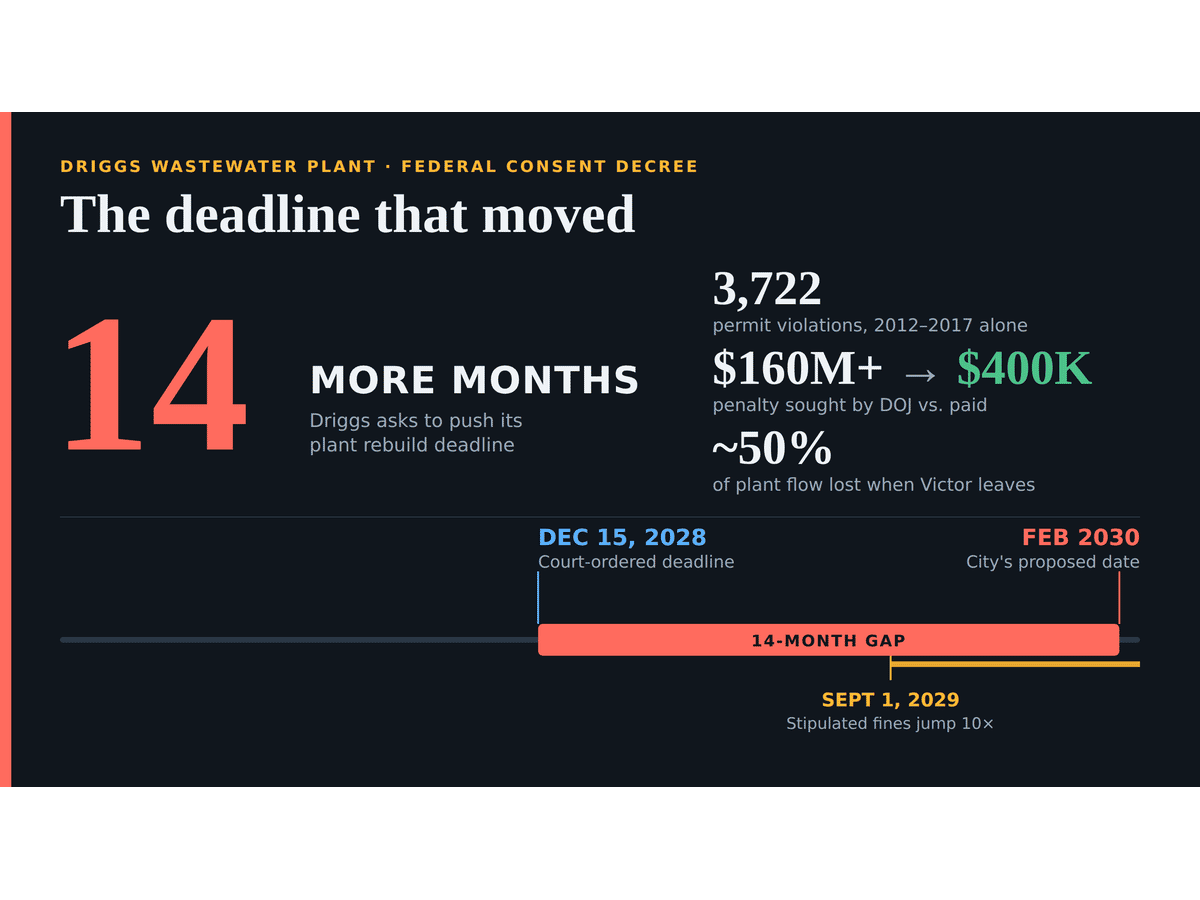
DRIGGS — The Driggs consent decree set a hard federal deadline to rebuild the city's wastewater treatment plant by Dec. 15, 2028. The city now treats February 2030 as the deadline and is still working to secure the federal sign-off that would make the later date official.
The decree, in United States v. City of Driggs, Idaho et al. in the U.S. District Court for the District of Idaho, settles more than a decade of Clean Water Act enforcement and imposes a $400,000 penalty the city has paid, according to the EPA's Jan. 16, 2025 announcement. On April 30, 2026, Driggs filed a force majeure request seeking to move the operational deadline to February 2030. EPA Region 10 and the Department of Justice have not, on the public record, said whether they will grant it.
The Driggs consent decree remains the fixed point the rebuild bends around. Its central deadline is now unsettled: the date by which the city must have a rebuilt plant that meets its federal permit limits.
What the decree requires
The Driggs consent decree was lodged in federal court on Jan. 15, 2025 and noticed in the Federal Register on Jan. 22, 2025 (Doc. 2025-01480), opening a 30-day public comment period that closed on Feb. 21. The court entered the decree as final on Nov. 20, 2025.
Three substantive obligations come out of it:
- Pay a $400,000 civil penalty. The Department of Justice sought more than $160 million in civil penalties when it filed its complaint in October 2022 (Victor v. Driggs complaint, ¶51).
- Rebuild the treatment plant to meet the limits of National Pollutant Discharge Elimination System Permit ID0020141, with the new facility operational by Dec. 15, 2028.
- Report quarterly to EPA Region 10 and the Department of Justice on design milestones, construction progress, and effluent compliance.
Stipulated penalties, predetermined fines for missed milestones, are set out in Section IX. They scale from $500 to $2,000 per effluent-limit violation through Aug. 31, 2029, then increase tenfold once the rebuilt plant is operational on Sept. 1, 2029: $5,000 to $20,000 per violation. Sampling failures and missed upgrade-plan deadlines carry separate penalties of $500 to $2,500 per day.
A 20-year violation record
The plant serves about 5,573 people: roughly 1,984 in Driggs proper, plus residents of Victor and unincorporated Teton County, under a long-standing intercity agreement. It discharges to a drainage ditch that flows into Woods Creek, which carries to the Teton River and onward via the Snake and Columbia rivers to the Pacific. Woods Creek is a state-designated impaired water body, listed under Idaho's 303(d) program for pathogen contamination. The plant's effluent ammonia limit, set at 0.84 milligrams per liter monthly average under its 2010 NPDES permit fact sheet, has been the city's chronic compliance gap.
The federal record begins in 2006, when the EPA cited Driggs for 1,459 permit violations and assessed a $4,000 penalty, per the agency's archived release. Driggs converted its treatment plant in 2013. The new plant did not solve the problem.
Between November 2012 and June 2017, the EPA documented 3,722 additional permit violations and resolved them under a 2018 Consent Agreement and Final Order that took effect April 26, 2018. The order required Driggs to identify corrective actions within 12 months, complete plant modifications within 24 months, and achieve effluent-limit compliance within that same 24-month window. The city missed all three deadlines and has been in violation of the order since April 29, 2019 (United States v. City of Driggs amended complaint, ¶¶45–47). The 2018 settlement also imposed a $13,500 penalty.
The Department of Justice filed its complaint in October 2022, citing more than 3,200 documented permit violations between July 2017 and July 2022, itemized month by month in an appendix to the federal complaint, and ammonia discharges that EPA ECHO discharge monitoring records show exceeded permit limits by more than 36,000 pounds in both 2022 and 2023, figures the Idaho Conservation League's annual analysis corroborated. The case resolved with the January 2025 consent decree.
The plant the decree ordered
The rebuilt plant uses an activated sludge process with a Kubota Membrane USA membrane bioreactor. Forsgren Associates is the engineering firm of record. The city hired Forsgren in April 2024 to design a combined plant sized for 20 years of growth in both Driggs and Victor, and Forsgren delivered 60% design plans in February 2025. The next month, Victor moved to terminate the inter-city agreement. The combined design was built around Victor's flows, so Driggs never finished it. The city sent Forsgren back to redesign a smaller plant for Driggs alone.
That is the reason the decree's deadline is now in question.
The request to move the deadline
In its quarterly compliance report dated April 30, 2026, Driggs told EPA and the Justice Department it had "submitted a force majeure request to modify the consent decree timeline and associated compliance deadlines." The request, the report states, "is prompted by the City of Victor's withdrawal from the regional wastewater system, which will reduce influent flows and loading by approximately 50 percent." That reduction, the report says, forces "a comprehensive re-evaluation and re-design of the planned treatment facility."
The schedule Driggs proposed in that request runs well past the decree as entered: design completed in early 2027, construction bidding in February 2027, and construction from May 2027 to February 2030. That puts the new plant online 14 months after the court-ordered Dec. 15, 2028 deadline.
Driggs is already operating as though the later schedule governs. The April 30 report measures the city's progress against "the revised Schedule of Deadlines, proposed by the city as part of the force majeure request," and its June 2 council staff report states flatly that Driggs "is required by the EPA and Department of Justice to have the upgraded WWTP online and compliant in February of 2030 or it will be subject to significant fines." The consent decree the court entered still reads Dec. 15, 2028. The city's own documents now read February 2030.
How firmly the federal government has agreed is less clear. City staff told the council on June 2 that they still need EPA's approval to move the decree's deadlines under its force majeure clause, which allows extensions for events beyond the city's control, and that they were meeting EPA, the Justice Department, and Idaho DEQ on June 15 and 16 to settle the timeline. A nearer deadline is already pressing: a 90% design submittal due in early August, which staff said the city could miss if the council switches to a larger combined-plant design. City staff described the EPA as the agency that decides whether the deadline will be extended.
The dispute over Victor's departure, the redesign it forced, and the cost of building for one city or two is its own story. (See Build for one city or two: Driggs council to decide.) The narrower question here is what it does to the federal decree: a court-ordered deadline the city is asking to move, and a federal answer not yet on the public record.
How it gets paid for
Most of the funding came together outside the decree's direct mechanics. Idaho's Department of Environmental Quality placed Driggs at the top of its draft fiscal-year 2027 Clean Water State Revolving Fund priority list, making the city eligible for up to $25 million in loans and partial principal forgiveness. (See Driggs wastewater funding tops state list at $25 million.) That package was built around the original $31.6 million estimate for the combined-system design. The city has not disclosed what the redesigned plant will cost or how the financing will change as a result.
What to watch
- Mid-June. Driggs is set to meet with Idaho DEQ on June 15 and with the Justice Department and EPA on June 16, then take its design decision (a Driggs-only plant or a return to a combined design for both cities) to a council public hearing. Those meetings are where the force majeure request and the February 2030 schedule begin to get a federal answer.
- The next compliance report. Driggs files quarterly with EPA Region 10 and the Justice Department. The Q2 2026 report is due at the end of July.
- Early August. A 90% design submittal is due. If the council sends the engineers back to a combined-plant design on June 16, city staff said the city would miss that milestone, adding to what it needs the federal government to forgive.
- The deadline of record. The consent decree still reads Dec. 15, 2028; the city is working to February 2030. Which date governs turns on whether, and to what extent, EPA formally grants the force majeure extension.
Sources
- EPA: City of Driggs, Idaho pays $400K penalty for Clean Water Act violations (Jan. 16, 2025)
- Consent Decree, United States v. City of Driggs, Idaho et al., No. 4:22-cv-00444-DCN (D. Idaho), Doc. 29 (entered Nov. 20, 2025)
- Amended Complaint and Appendix A, United States v. City of Driggs, Doc. 27 / 27-1 (Oct. 24, 2022)
- Federal Register: Notice of Lodging of Proposed Consent Decree (Jan. 22, 2025), Doc. 2025-01480
- Driggs Q1 2026 quarterly compliance report (April 30, 2026)
- EPA ECHO Detailed Facility Report, NPDES ID0020141
- NPDES Permit ID0020141 Fact Sheet (2010)
- EPA: 2006 Driggs Clean Water Act settlement
- City of Driggs Wastewater Treatment Plant project page
- Driggs council staff report and DEQ rescission letter, June 2, 2026 packet
- Driggs City Council meeting, June 2, 2026 (60% design discussion)
- Complaint, City of Victor v. City of Driggs, No. CV41-26-0062 (Teton County District Court, Mar. 5, 2026)
- Build for one city or two: Driggs council to decide
- Driggs wastewater funding tops state list at $25 million
Subscribe
The Morning Signal
Teton Valley news, once or twice a week. The reporting is airtight. The introduction is unhinged.