The Wastewater Numbers Behind Victor's $35 Million Bet
Victor's $35 million wastewater plant costs $115,000 less per year than staying with Driggs. The wastewater numbers both cities have and haven't published.
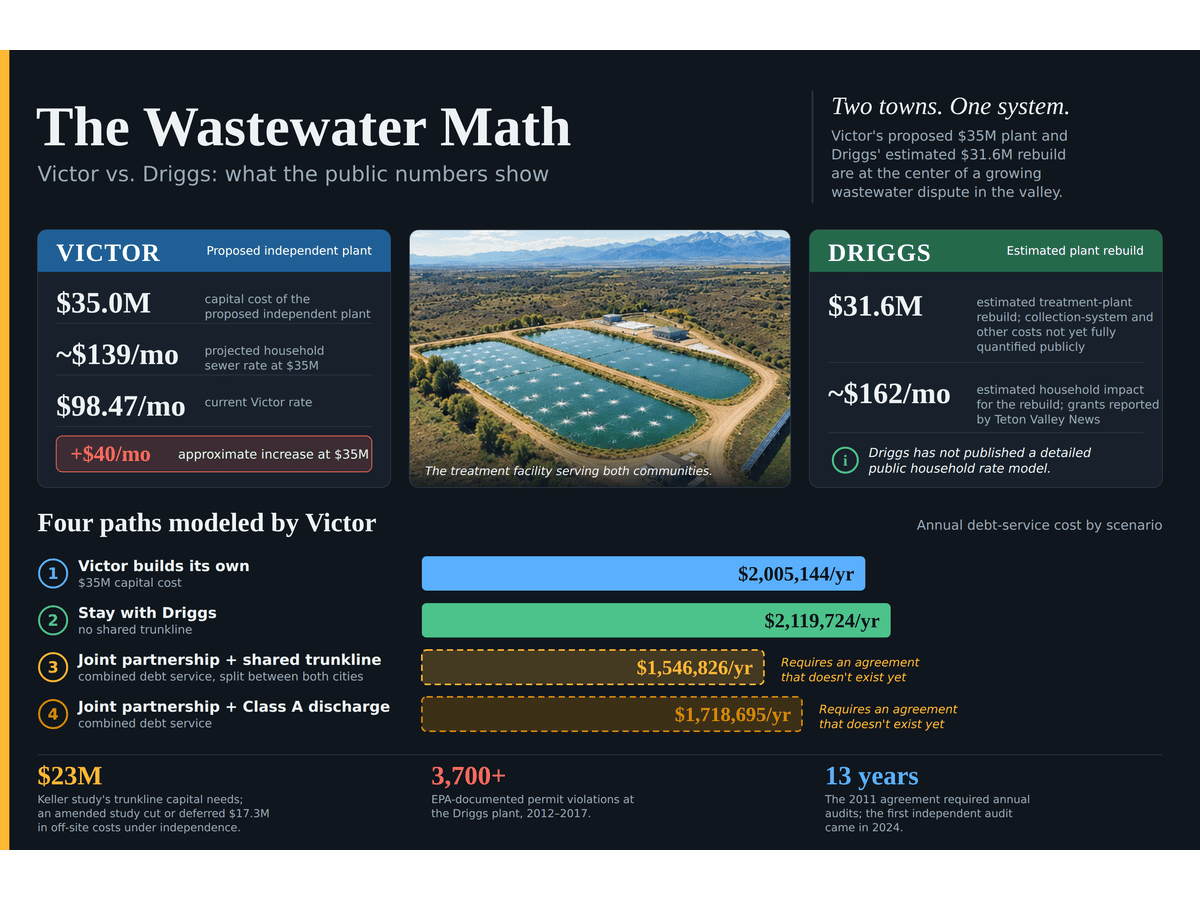
VICTOR — The wastewater numbers in the Victor-Driggs fight start at $35 million, the figure that has dominated the debate since Mayor Will Frohlich announced plans to build an independent treatment plant. Critics call it reckless. The recall petition cites it. Councilmember Amy Ross, the lone dissenting vote on the judicial confirmation, warned in January that she doesn't think "anyone understands the full financial implications of $35 million in debt."
The number deserves scrutiny. So does the number next to it. Staying with Driggs carries its own cost, and when you pull the financial documents both cities have made public, the gap between "build our own" and "stay on the Driggs system" is narrower than the headline suggests. Depending on which assumptions you use, it may not exist at all.
The Valley Signal spent the past week reviewing the wastewater numbers published by both cities: financial data, rate models, engineering studies, and public meeting records.
The four paths forward
Victor has modeled four alternatives, with wastewater numbers for each, along with annual debt service estimates based on 30-year financing at 4% through the Idaho Bond Bank.
Alternative 1: Victor builds its own plant. Capital cost: $35 million. Victor's annual debt service: $2,005,144.
Alternative 2: Victor stays with Driggs under a partnership model without shared trunkline costs. Victor's annual debt service: $2,119,724.
Under the arrangement closest to the status quo, in which Victor continues to send its wastewater to Driggs and shares in capital costs, Victor would pay roughly $115,000 more per year than it would by building its own facility. Without a joint powers agreement covering the trunkline, Victor bears trunkline capital expenses in addition to its share of plant costs. Independence is cheaper than the current structure.
Alternative 3: Joint partnership with shared trunkline. Combined debt service: $1,546,826, split between both cities.
Alternative 4: Joint partnership with trunkline and Class A discharge. Combined debt service: $1,718,695.
Alternatives 3 and 4 would cost Victor less on paper. They require a joint powers agreement that doesn't exist. Mediation between the cities failed in January after a nine-hour session. Victor sued Driggs on March 5. No partnership framework is on the table. These numbers are theoretical.
The cost of staying
Driggs is under a federal consent decree requiring a complete plant rebuild. The EPA estimated the treatment plant cost at $25 million in January 2025. By December 2025, Forsgren Associates' 30% design estimate had risen to $31.6 million. That figure covers only the treatment plant: the membrane bioreactor system, equalization basins, biosolids handling, and related treatment infrastructure. It does not include collection system improvements, which are the subject of a separate Keller Associates study presented to the Driggs City Council on March 3.
The consent decree schedule calls for construction to begin in May 2026 and the plant to be fully online by January 2029. Whether that timeline holds is an open question: Driggs has not published a rate model or publicly detailed its financing plan for the project.
Victor's $35 million covers a complete new facility on a greenfield 40-acre site, including site work, treatment systems, and all associated infrastructure. Driggs' $31.6 million covers a treatment plant rebuild on the existing site, with collection system costs additional and not yet quantified publicly. The two numbers are not directly comparable without knowing Driggs' full infrastructure bill.
The Teton Valley News calculated that without grant funding, the treatment plant rebuild alone would add approximately $162 per month to Driggs' household sewer bills, spread across roughly 1,176 connections over a 20-year amortization period.
If Victor had stayed on the system, its ratepayers would have been exposed to a share of that rebuild, on a plant Victor doesn't own, didn't design, and has no operational control over. The Idaho Conservation League ranked the Driggs plant among Idaho's three worst-performing wastewater facilities. The EPA documented more than 3,700 permit violations between 2012 and 2017. In both 2022 and 2023, the plant discharged approximately 36,000 pounds of ammonia, exceeding its permit limits by roughly 25 times, according to data from the Idaho Conservation League. Preston, Driggs, and Plummer accounted for 31% of all wastewater violations statewide in 2024.
Then there's the trunkline. The Keller Associates facility planning study, completed in February 2025 before the independence decision, identified approximately $23 million in capital improvements needed between Victor's northernmost lift station and the Driggs plant across all planning horizons. Keller attributed roughly $10 million to Victor, $13 million to Driggs. Victor's financial documents used a $20 million "placeholder" for its potential trunkline exposure in the status quo alternative.
But most of those costs exist only if Victor stays on the Driggs system. When Keller issued Amendment 1 in August 2025, revising its recommendations to reflect the independence decision, the revised study eliminated or deferred $17.3 million in off-site infrastructure costs. Without Victor's flows, the Driggs South Lift Station no longer approaches firm capacity. The force main serving it doesn't need upsizing. The interceptor upgrades along Highway 33 between the two cities, totaling more than $10 million in Priority 2 improvements alone, are entirely absent from Victor's capital improvement plan. All figures are in 2024 dollars.
Staying on the Driggs system exposes Victor to its share of the plant rebuild and triggers improvements to the shared collection infrastructure that the independence path avoids. Victor's proportional share of the Driggs rebuild, plus trunkline exposure that Keller's amended study shows is deferrable under independence, plus ongoing operations and maintenance payments: under the status quo, Victor faced somewhere north of $27 million in total exposure, without local control and without ownership of the asset.
Victor's own January cost analysis, reported by the Teton Valley News, found the shared infrastructure path would cost roughly $27 million, about $8 million less than going independent. But both projects are in early planning stages. The Driggs rebuild has already risen from $25 million to $31.6 million between January and December 2025. Construction cost inflation for similar projects has run 22% to 100% since 2021, according to Keller Associates data. At this phase of engineering, a $4 million difference between two multimillion-dollar infrastructure projects is within the margin of a rounding error.
The council voted 3-0 in March 2025 to build the independent plant. Victor chose to own the asset, control operations, and enable continued growth on the infrastructure it governs.
What $35 million builds versus what $31.6 million fixes
Victor's proposed facility is designed to produce Class A reclaimed water, the highest quality tier Idaho permits for reuse. The system uses biological treatment, filtration, disinfection, and continuous monitoring. Class A water can irrigate parks, school fields, and landscaping. With the right permits and site conditions, it can recharge groundwater through engineered infiltration basins.
The Driggs rebuild is a membrane bioreactor system using Kubota Membrane USA technology, designed by Forsgren Associates. It will bring an existing noncompliant plant into compliance with its discharge permit. It will produce cleaner effluent than the current plant. Forsgren engineered it to meet existing regulatory minimums, not to achieve reuse or recharge.
Idaho operates under a prior-appropriation water system. Communities with junior water rights, and much of the Upper Snake River Plain, qualify and face increasing pressure during shortages as the state expands groundwater monitoring and curtailment enforcement. A facility that can produce permitted aquifer recharge gives Victor a long-term strategic asset: the ability to put treated water back into the ground rather than sending it downstream. In a semi-arid valley that relies on groundwater and is growing at 2.3% annually, that capacity could shape whether the city can sustain its growth.
The Driggs plant requires four full-time treatment operators. Victor projects two part-time operators for its proposed facility, with estimated annual plant operating expenses of approximately $300,000. Victor already employs personnel to operate its collection system, so staffing overhead for an independent plant is incremental.
What residents would pay
Victor has modeled the household impact. At a total capital cost of $35 million, the projected monthly sewer rate is approximately $139 per equivalent residential unit.** At $30 million, it drops to about $127. The current Victor sewer rate is $98.47 per month.
That is an increase of $28 to $40 per month.
Victor's sewer fund holds approximately $3.5 million. The city raised rates in the past year in anticipation of higher charges from Driggs that haven't yet been billed. At the March 25 Victor City Council meeting, members of the public alleged the city was misusing sewer fund revenues. City financial records do not support that claim. The fund balance reflects the rate increase the council approved to prepare for infrastructure costs, whether those costs came from Driggs or from an independent plant.
Neither rate model assumes grant funding. Every $1 million in awarded grants reduces the monthly household rate by approximately $2.50. A $5 million award, well within the range of what USDA Rural Development or Idaho DEQ State Revolving Fund programs provide, would bring the increase to roughly $15 to $28 per month.
Both cities are pursuing grant funding through Altura Community Consulting. Victor is proposing a new, purpose-built Class A facility designed to exceed standards, built by a growing community investing in its own infrastructure. Driggs is seeking funding for a federally mandated rebuild of a plant that the DOJ sued for chronic noncompliance. Grant agencies weigh project quality, community investment, and compliance history in their scoring.
The number Driggs hasn't published
Driggs has not released a detailed public rate model for its ratepayers. The city's website asks how much sewer rates will increase, and answers: "It depends."
Victor has published its wastewater numbers: projected monthly rates ($127 to $139), annual debt service figures for four alternatives, and capital cost estimates at multiple design phases. Driggs has published the consent decree timeline and facility descriptions, but not a household rate projection that incorporates the rebuild, grant assumptions, and financing terms.
The financing plan behind Driggs' $31.6 million project is incomplete. The city applied to Idaho DEQ's Clean Water State Revolving Fund for a below-market loan but ranked fourth in the most recent funding cycle. The top three applicants were selected. No award has been announced. Driggs has contracted Altura Community Consulting to pursue grants, but no specific grant applications or dollar amounts have been made public. Mayor August Christensen told the Teton Valley News that "this is one area that could use more funding" and that the city is working to "find creative ways to offset the costs to utility rates."
The consent decree timeline calls for construction bidding in February 2026 and a May 2026 start. Nothing in the public record ties that schedule to securing SRF funding or grants. If the grants don't materialize, the full $31.6 million falls to municipal bonds, and the full $162 per month falls to Driggs ratepayers. The consent decree deadline, December 15, 2028, does not move.
Both cities, competing for overlapping grant pools with the same consultant, face the same math: every dollar not covered by grants is a dollar financed through rates. Victor has published what its ratepayers would pay under that scenario. Driggs has not.
The most important missing figure remains what Victor's monthly rate would have been over 20 to 30 years had it stayed on the Driggs system through the rebuild. That requires stacking Victor's proportional share of the $31 million plant upgrade, the trunkline improvements, ongoing operations and maintenance payments, and whatever rate increases Driggs passes through for its own collection system investments. No one has publicly assembled those wastewater numbers.
13 years without an audit
The 2011 Inter-City Agreement between Victor and Driggs required annual independent audits of the shared wastewater finances. The first independent audit was not conducted until 2024, according to documents cited in Victor's lawsuit. For 13 years, neither city verified whether the cost-sharing was accurate.
Victor's complaint alleges the audit revealed overbilling: Driggs collected more than $300,000 in debt service payments between 2014 and 2016 that were not applied toward debt reduction. Victor alleges Driggs failed to fully cooperate with the audit process.
Thirteen years of unaudited wastewater numbers and cost-sharing on a multimillion-dollar infrastructure agreement. The overbilling allegation, if proven, represents a fraction of the total Victor wastewater cost exposure during that period.
What to watch
Read our full coverage of the Victor-Driggs lawsuit and the allegations behind it.
April 7: Judge Steven Boyce hears Victor's petition to authorize borrowing under Idaho's Judicial Confirmation Law. The law allows a municipality to incur long-term debt for projects deemed "ordinary and necessary" without a voter referendum. If approved, Victor can proceed with financing. If denied, the city would need voter approval through a bond election, a more uncertain path with a recall effort already underway.
Grant announcements: Every dollar awarded narrows the gap for one side or the other.
Driggs rate model: When Driggs publishes a household rate projection, and it must be before financing the rebuild, the valley will have a number to put next to Victor's $139. Driggs Mayor Christensen told the Teton Valley News that Victor's withdrawal forced $500,000 in redesign costs and a one-year delay on the 60% design. If Driggs passes those costs on to ratepayers, the consent-decree rebuild becomes more expensive.
Sources: City of Victor and City of Driggs public financial documents, rate models, and project pages; EPA consent decree and press release, January 2025; U.S. v. City of Driggs, Idaho (DOJ consent decree); Victor v. Driggs complaint, CV-41-26-0062, Teton County District Court; Keller Associates wastewater facilities planning study; Forsgren Associates design documents; Idaho DEQ Clean Water State Revolving Fund program records; Idaho Conservation League 2024 wastewater violations report; Teton Valley News reporting by Connor Shea, February-March 2026; Jackson Hole News & Guide reporting on mediation documents and lawsuit, February-March 2026.
Subscribe
The Morning Signal
Teton Valley news, once or twice a week. The reporting is airtight. The introduction is unhinged.