The Sin Bin: The Ethics Hall Monitor Has Entered the Chat
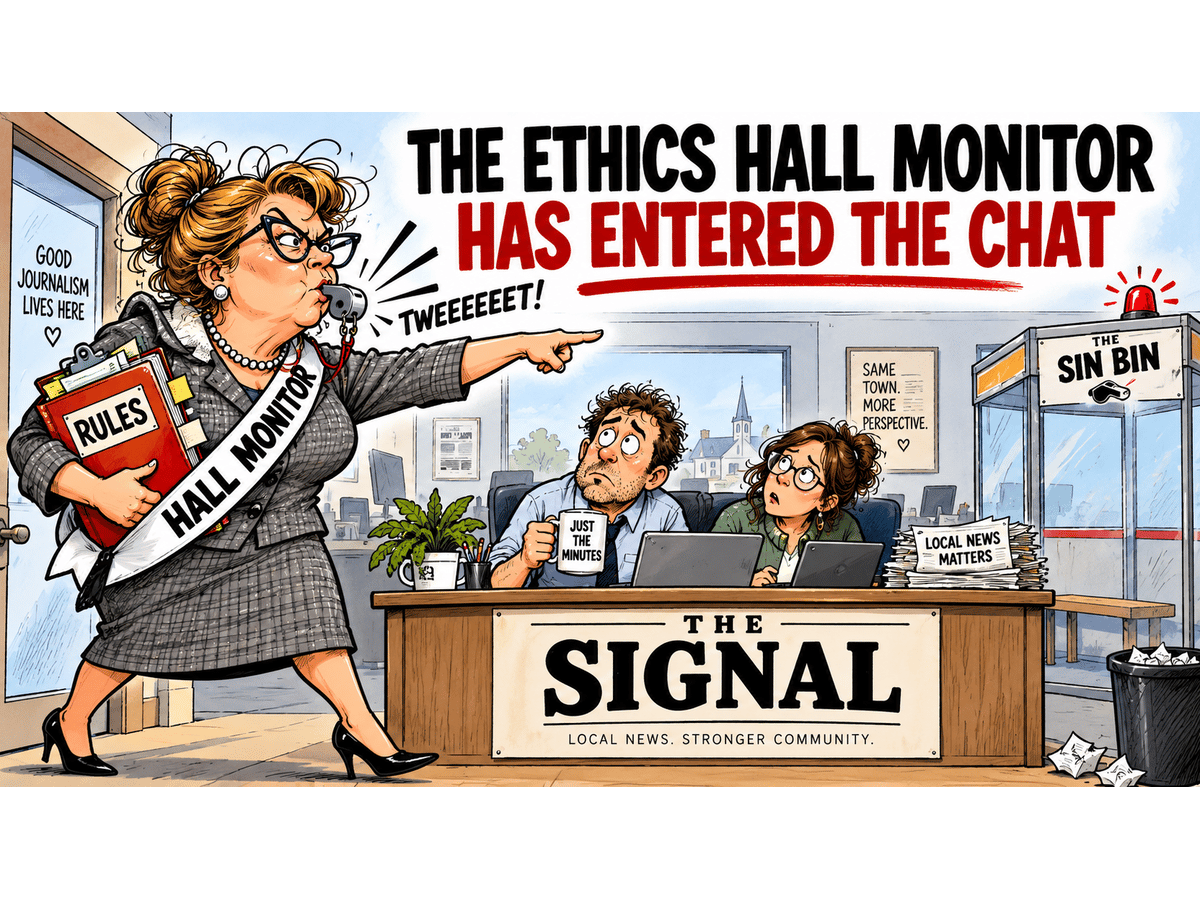
The Sin Bin answers a reader who accused The Valley Signal of ethics violations over its "Signal Staff" byline. Sully calls it hall-monitor cosplay.
What is this? The Sin Bin is The Valley Signal’s advice column for people who don’t deserve it. The sin bin is the penalty box, where you go when you’ve screwed up. You write in with the mess you’ve made of your life, or your neighbor’s, and Sully tells you what you already know but you’re too soft to admit. No soft problems. No participation trophies. No closure. Every story has a pylon, the useless person standing there while the play moves around them. If you can’t spot yours, it’s you. Keep it short or get benched, and send it to [email protected].
Dear Sully,
A reader wrote in to The Valley Signal to accuse the paper of violating journalistic standards because some factual public-record pieces carry a “Signal Staff” byline instead of an individual named author.
She argued that “Staff” is not a real byline, that unnamed authorship is anonymous publishing, that anonymous publishing is basically advocacy, that the Federalist Papers don’t count because they were propaganda, that SPJ ethics require named attribution, that elected officials or city staff might secretly be writing opinion pieces, and that the paper should update its disclosures to admit its content is advocacy rather than journalism.
For context: the owner’s name is public, the publication’s contact information is public, opinion pieces are labeled, and the pieces using the staff byline are factual items compiled from public records, meeting materials, official filings, agendas, minutes, recordings, and similar sources.
She then asked, “Why are you opposed to transparency and accountability?”
— Staff Infection in Deep South Victor
Ah, beautiful.
Nothing like a local resident discovering media ethics at 11:47 in the morning and achieving full Woodward by lunch.
Let’s start with the obvious: “Staff” is a byline. It may not be the byline she wants. It may not satisfy her deep personal need to know which poor bastard summarized the planning agenda. But it is a byline. Newspapers have used staff bylines forever for briefs, roundups, public-record summaries, notices, incident reports, and other pieces where the author is not the story unless you are the sort of person who brings a clipboard to a lemonade stand.
This is not shadow government. This is not Watergate. This is not an anonymous pamphlet campaign by a cabal of zoning commissioners in fake mustaches.
It’s a staff byline.
Now, could a publication explain its byline policy more clearly? Sure. Put it on the About page. “Signal Staff” means factual public-record work compiled by the publication. Opinion gets labeled. Outside submissions get named unless there is a real reason not to. Public officials don’t get to anonymously launder opinions about public business through the paper.
There. Fixed. Somebody alert the journalism Vatican.
But that’s not really what happened here.
What happened is the reader found a small procedural knob and tried to turn it into a federal indictment. She did not write, “Hey, can you clarify what Signal Staff means?” That would be normal. That would be useful. That would be the kind of thing a reader asks when she wants the paper to improve.
Instead, she backed the ethics dump truck into the inbox and unloaded the whole quarry.
SPJ. The Federalist Papers. Propaganda. Watchdog obligations. Public trust. Government officials. Advocacy. Disclosure. Accountability. Transparency.
Buddy, it’s a local news site in Teton Valley, not a Chilean coup.
The move she made is a classic small-town specialty: take one halfway reasonable concern, wrap it in seven layers of moral panic, then ask a question that is not a question.
“Why are you opposed to transparency and accountability?”
That’s not curiosity. That’s a trapdoor.
It is the same trick as asking, “When did you stop stealing office supplies?” You can answer it, sure, but now you’re already standing in the defendant’s box while someone who just learned the phrase “public trust” bangs a soup ladle on the counter.
And here’s the part that gives the game away: she knows who runs the publication.
She knows where to send the complaint. She knows the website. She knows the email. She knows the owner’s name. She knows enough about the About page to argue with it. She knows enough about the site to object to its bylines. She knows enough to compare it to another local publication and bring in a prior grievance from that fight.
So the idea that this is some accountability black hole is nonsense. She found the accountable person immediately. Then she accused him of being unreachable while reaching him.
That’s not watchdogging. That’s biting the mailman after he hands you the mail.
The pylon here is the reader.
She wants to be treated like the Society of Professional Journalists because she can quote them. Sorry, pal. Reading the rulebook does not make you the referee. It makes you a person with internet access.
There is a difference between asking a paper to be clear and demanding it confess to being propaganda because you dislike a byline convention. One is civic engagement. The other is performance art for people who use “accountability” the way teenagers use Axe body spray.
Also, let’s retire this little fantasy that every unsigned institutional item is automatically suspicious. Not everything needs a named author. Some things are produced by an operation. That is why “staff” exists. It tells the reader: this came from the publication, not a guest columnist, not an outside crank, not someone selling supplements out of a Subaru.
If the facts are from the public record, cite the record. If the piece is opinion, label it opinion. If there is a conflict, disclose it. If a public official wants to publish a secret hit piece on a local issue, throw it in the harbor.
Those are standards. Normal ones. Useful ones.
But “I demand your public-record briefs carry the individual name of whoever typed them, or else your whole newspaper is advocacy”? No. That’s not ethics. That’s hall-monitor cosplay.
So what should The Valley Signal do?
Publish a byline policy. Make it boring. Make it clear. Do it once. Then stop feeding every passing inbox prosecutor who thinks local journalism should operate like a Senate confirmation hearing.
Because if you let every self-appointed referee stop the game, eventually nobody plays hockey. You just have six people standing around arguing about the whistle while the puck sits there wondering what it did wrong.
Sully’s Verdict: Two minutes for ethics cosplay, plus a misconduct for trying to turn “Staff” into Deep Throat.
Subscribe
The Morning Signal
Teton Valley news, once or twice a week. The reporting is airtight. The introduction is unhinged.