Teton County Puts Off a Midway Substation Decision as All Three Commissioners Voice Doubts
Teton County commissioners closed the Midway substation hearing without a vote and sent the competing studies to staff. All three voiced doubts.

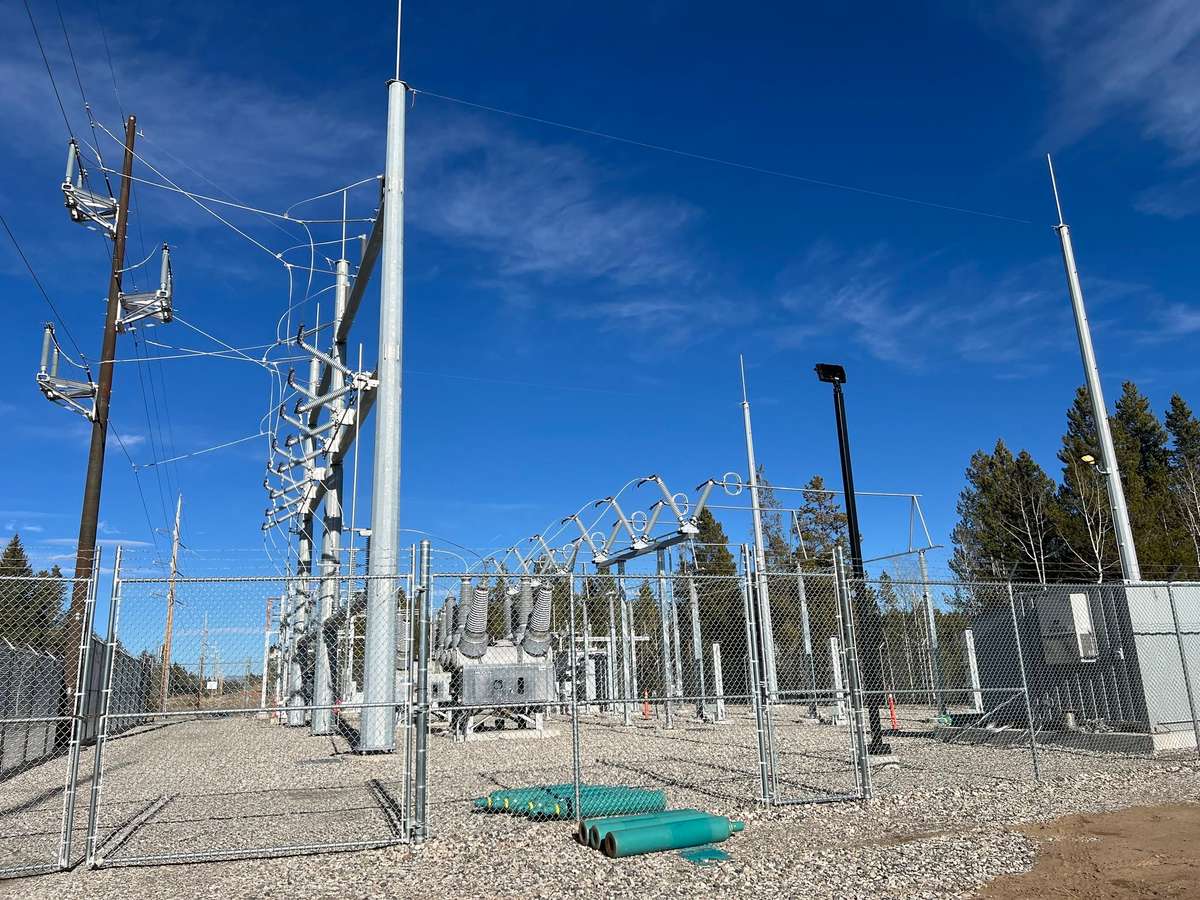
DRIGGS — Teton County commissioners closed the public hearing on Fall River Electric's second Midway substation application Monday without deciding it. They sent the competing technical studies to the county's planning administrator to compare first, and set no date to finish.
The board denied the first application 2-1 in March, with Commissioners Dan Powers and Ron James in the majority, and Chair Brad Wolfe dissenting. It found the substation incompatible with the surrounding homes and its impacts beyond mitigation. Fall River refiled the Midway substation on the same parcel near 700 W. 3500 S. in August, adding a wildlife assessment and 4.25 acres of permanent open space. The county Planning and Zoning Commission recommended approval 4-3 on Sept. 8.
Taylor Cook of Nelson Engineering presented for Fall River. "The substation must be centrally positioned between Victor and Driggs," he said. "If it were too far south, it could not effectively back up the Driggs substation. If too far north, it cannot effectively back up the Victor substation." The Bonneville Power Administration line runs along the parcel's west boundary, and the substation would connect directly to it.
Claire Pincock of MD Acoustics, who prepared Fall River's noise and EMF studies, and Sarah Taubitz of Altitude Acoustics defended the noise survey. Doug Bell of Cavanaugh Tocci Associates, the consultant the neighbors hired, told commissioners the substation would produce "an audible hum that will be observed by the neighbors almost on a continuous basis."
More than 20 people spoke against the Midway substation, and a handful spoke for it. Victor Public Works Director Cole Pendell, speaking for the city, said, "Reliable electrical service is essential to the continued operation of our municipal water and wastewater systems." Anna Trentadue, the attorney for two neighbors whose land adjoins the site, asked the board to have staff analyze the studies the neighbors had submitted, which she said the staff report had not factored in, "unless you choose to just outright deny this entirely, which would also be appropriate."
In March, the board's written decision recorded that Wolfe "felt he could support approval of the application if there was a way to adequately mitigate visual impacts and noise." Opening deliberation Monday, he called Trentadue's request "not a bad idea" and asked whether anyone remembered Spock's line that "the needs of the many outweigh the needs of the few." He went on: "I just want to be very sure … we aren't asking too much of the few, and it seems like we might be." He described himself as undecided: "When one side talks, I go, yeah, they're right. And then the other side talks, I go, yeah, they're right. That to me says I need more information."
When a utility has to buy pricier land, "I assume rates go up," Wolfe said. Spreading a small increase across all of the cooperative's members, he said, "shares the cost instead of just one area."
The 30 or so people who live nearby, Powers said, "are being asked to bear the burden of that development," meaning growth the county has approved. "They want to keep living there, and it's just hard for me to imagine how this is going to be compatible with that." He called Fall River's service "incredibly reliable" and said he applauds the land it set aside along the creek for wildlife. "I am concerned that there isn't room for growth here," he said. The wildlife plan had to meet "a 2-to-1 ratio" of protected land to disturbed land. "But what if they need to impact another acre? Is there another 2 acres that they have available to mitigate? … We're not future-proofing this."
James asked Fall River CEO Bryan Case for a plan to make up for lower property values, saying he had heard "a lot of technical information" but nothing on that. When the board deliberated, James said, "I just think that's a bad, bad place to put a power station." Later he added, "I want to see those other reports before I make a decision."
"The board has given me authorization to figure out how we mitigate that," Case answered. "So whether the county requires it or not, we'll have conversations with those adjacent property owners." Fall River's legal team has worked out a process using a mediator and "licensed qualified appraisers," he said, and "with this approval going forward, we would address that."
In June, Case told commissioners the effect on values was "fairly small, anywhere from 3 to 6%." The study Fall River filed with its application, of Salt Lake County home sales from 2001 to 2014, estimated a 2.9% drop for homes within about 160 feet of a substation. Past that distance, it found no measurable effect. Trentadue told commissioners that "that number is just not credible."
"The accusation that Fall River has just picked one site and that's it, that's blatantly false," Case said. "We've talked to several property owners that have just said no." And "at this very moment," he said, something else had come up. If Fall River can "secure a deal" that better fits its criteria, "we'd be back in front of you with that." The owners of a nearby industrial site, Case told commissioners in June, "gave us the outlandish number."
"If we're just asking to compile the information we received and have that presented back to us, then that's not new information," Wolfe said. "So we wouldn't need to continue the public hearing; we just need to continue the deliberation." He then moved to continue it "to consider the presented information and studies presented at this meeting," and the board approved the motion unanimously. The item will come back as an action item on a future agenda.
Planning administrator Joshua Chase had told the board at the start that the noise and EMF studies were "outside of my area of expertise." Comparing them, he said, "I'm willing to take a shot at that, but I might be that translator that doesn't get some things correct." He offered "a kind of cursory comparison to say, here's what this found, here's what … this found differently," and said he would "try to not reach a lot of conclusions."
Free newsletter
The Morning Signal
Teton Valley news, once or twice a week. The reporting is airtight. The introduction is unhinged.
Free. Unsubscribe anytime.
Sources for this story
- Teton County BOCC Agenda, Oct. 26, 2026
- BOCC Staff Report, Fall River Electric Special Use Permit
- Public Comments, Packet Attachment K
- BOCC Written Decision, Apr. 13, 2026
- Teton County Denies Midway Substation Permit
- Fall River Refiles the Midway Substation on the Parcel It Was Denied
- Fall River's Midway Substation: Industrial Lots or the Denied Site