Forest Service Approves Grand Targhee Expansion. The Permit Chain Runs Through Wyoming.
The Forest Service approved a 694-acre Grand Targhee expansion May 28. The downstream permit chain runs through Wyoming agencies, not Idaho.
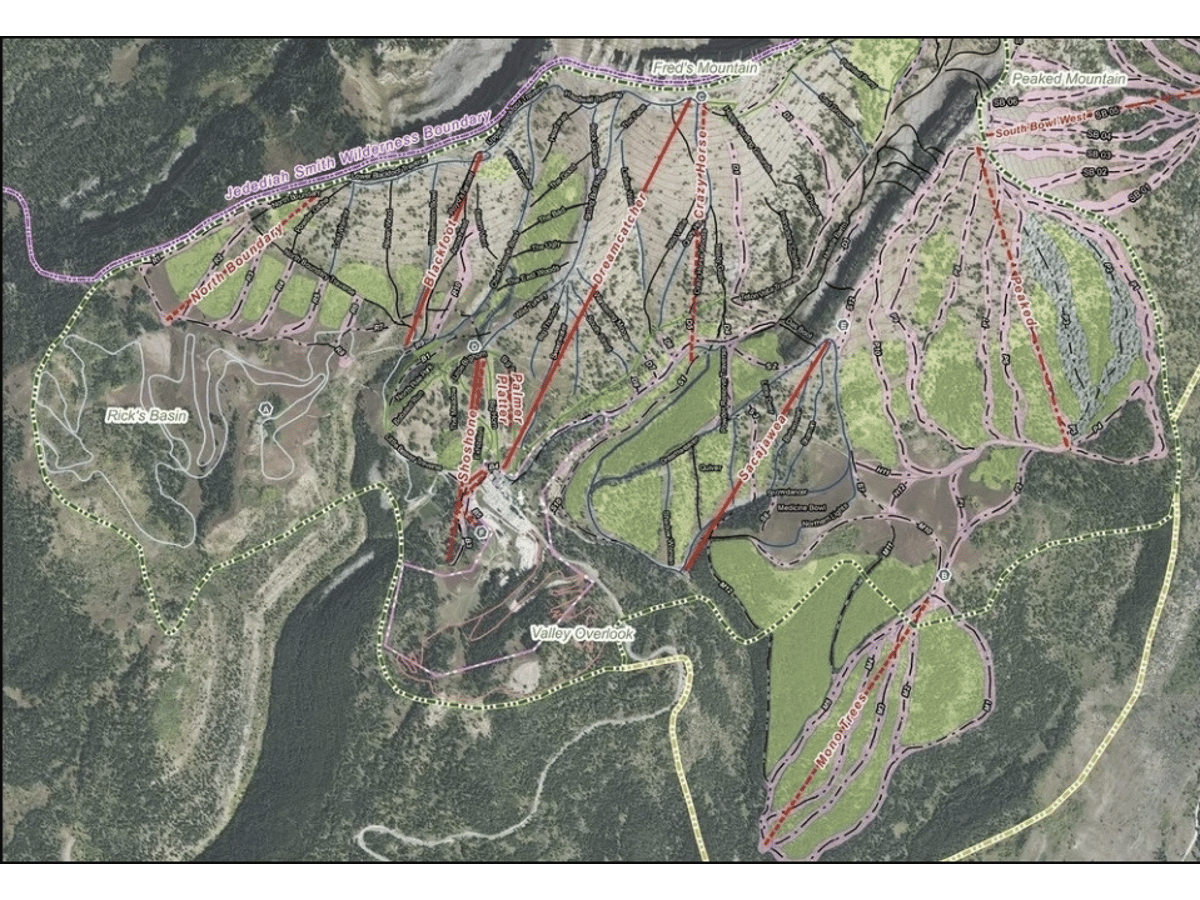
ALTA — The Caribou-Targhee National Forest signed a draft Record of Decision (ROD) on May 28 approving a 694-acre Grand Targhee expansion, extending the resort's special-use permit boundary. The agency opened parallel 45- and 60-day objection windows on May 29, when the Idaho Falls Post Register published the legal notice.
Forest Supervisor Kim Pierson signed about two months ahead of the agency's prior July 2026 estimate. She selected a modified version of the resort's proposed Alternative 2, approving 235 acres of expansion in the South Bowl area and 459 acres in Mono Trees, or about 80 percent of the 866 acres the resort had requested in the 2025 Draft Environmental Impact Statement (DEIS). The reductions in both areas reflect wildlife concerns raised during the public review, including a request from the Wyoming Game and Fish Department to remove the Mono Trees boundary from the mapped mule deer winter range.
The draft ROD does not authorize construction. Before the resort can break ground, it must clear concurrence from the U.S. Fish and Wildlife Service on three "likely to adversely affect" determinations covering grizzly bear, North American wolverine, and whitebark pine; obtain a Section 404 permit from the U.S. Army Corps of Engineers; receive Wyoming Department of Environmental Quality permits for stormwater discharge and construction; secure well permits from the Wyoming State Engineer's Office for the snowmaking and potable water it has added; satisfy Teton County, Wyoming's Dark Skies Land Development Regulations on lighting; and obtain Whitebark Pine Friendly Ski Area certification from the Whitebark Pine Ecosystem Foundation. None of those permits is an Idaho permit.
The federal, state, and county approvals downstream of the Forest Service all sit on the Wyoming side of the Teton Range. The road access, workforce, housing demand, and school enrollment generated by a 10-year expansion buildout are Idaho's.
Pierson invoked a recent U.S. Supreme Court decision to explain why her analysis stopped at the state line. The ruling, Seven County Infrastructure Coalition v. Eagle County, was issued May 29, 2025, one year to the day before the Forest Service published its legal notice. In the ROD, Pierson wrote that the Court had ruled the National Environmental Policy Act (NEPA) "is 'the proposed action' – that is, the project at hand," and that federal agencies "are not required to analyze the effects of projects over which they do not exercise regulatory authority."
"My purview as the Forest Supervisor is limited to actions on federal lands," Pierson wrote in the ROD. The Final Environmental Impact Statement (FEIS), she noted, contains "substantially more analysis than is now required" by the Seven County standard, including the cross-state housing and growth dynamics that have shaped Teton Valley's public response to the Grand Targhee expansion since 2018. The Forest Service disclosed the analysis but did not base the decision on it.
Teton County, Idaho, was a cooperating agency on the FEIS, a procedural role that gives a local government a seat at the NEPA table but no permitting authority and no formal veto. On May 27, the day before Pierson signed the ROD, the Teton County, Idaho, Board of County Commissioners voted to contribute $5,000 toward a cross-state academic workshop on the socioeconomic impacts of the Grand Targhee expansion, co-facilitated by the University of Wyoming's Ruckelshaus Institute and the University of Idaho's McClure Center. The vote went 3-0 only on the second attempt. Commissioner Ron James laid out the cross-state asymmetry in numbers: "3 million in their tax revenue and 275,000 in our tax revenue," he said of Teton County, Wyoming. "We're getting crumbs off of this," James said. Idaho absorbs road wear, landfill volume, and first-responder costs from a resort whose sales taxes flow to Wyoming. He voted "begrudgingly, aye" on a re-vote, after County Clerk Kim Keeley advised that the contingency-fund withdrawal required unanimity. Commissioners Brad Wolfe and Dan Powers voted yes.
Wolfe framed the $5,000 contribution as "an investment," arguing the county would "recoup it and much more in the future" by securing a direct revenue mechanism, such as a 1-to-2% impact fee on Grand Targhee visitors that would flow back to Teton County, Idaho. No legal pathway for such a fee was identified; any cross-state mechanism would require action by the Wyoming legislature, the Idaho legislature, or both. The board also agreed to write to Idaho's congressional delegation and state representatives, requesting help negotiating a more even arrangement. The workshop is planned for the Teton County, Idaho, courthouse in Driggs, with the date not yet announced. It is one of the few venues outside the Forest Service's narrow scope where the Idaho-side spillover from a Wyoming federal decision can be examined.
Hours later, Teton County Fire & Rescue Chief Mike Maltaverne presented one working cross-state arrangement to the same board: a $580,000-a-year contract under which Teton County, Wyoming, pays Teton County Fire & Rescue to provide fire and EMS services to Alta and Grand Targhee. The contract covers emergency response load, not the broader sales-tax asymmetry James named, but it is the only working revenue mechanism Idaho has from the Wyoming side. See: Fire Chief and BOCC Will Form Committee to Rebuild Dispatch Services Agreement.
Only individuals or organizations that submitted substantive written comments during the 2025 DEIS comment period are eligible to file an objection. Electronic objections may be filed at https://cara.fs2c.usda.gov/Public/CommentInput?Project=58258, with "Grand Targhee Master Development Plan Projects" in the subject line.
What to watch: The 45-day window for objections to the project decision and its five species-specific Forest Plan amendments closes July 13. The 60-day window for the programmatic Forest Plan amendment, designated TNF RFP Amendment 8, closes July 28. The earliest the Forest Service could sign a Final Record of Decision is August 4, the fifth business day after the longer window closes, if no objections are filed.
Sources
- Forest Service Project Portal — Grand Targhee Resort, project #58258 (Draft ROD, FEIS, Post Register legal notice, and supporting documents)
- Federal Register Notice — Caribou-Targhee NF Plan Amendment, FR Doc 2026-10676 (§219 programmatic notice)
- Federal Register Notice of Availability — Grand Targhee FEIS, FR Doc 2026-10740 (§218 project notice)
- Forest Service press release on the draft decision
- Electronic objection portal — Forest Service CARA system
- Seven County Infrastructure Coalition v. Eagle County, No. 23-975
- Teton County, Idaho Board of County Commissioners regular meeting, May 26, 2026
- Fire Chief and BOCC Will Form Committee to Rebuild Dispatch Services Agreement
- Forest Service Pushes Grand Targhee Expansion Timeline Again
Subscribe
The Morning Signal
Teton Valley news, once or twice a week. The reporting is airtight. The introduction is unhinged.