ITD's Top Highway 33 Safety Fix Was Set for 2031. Now It's Unfunded.
ITD's top Highway 33 safety project, turn lanes at the 6000 South intersection, was set for 2031 and now has no funding after state budget cuts.
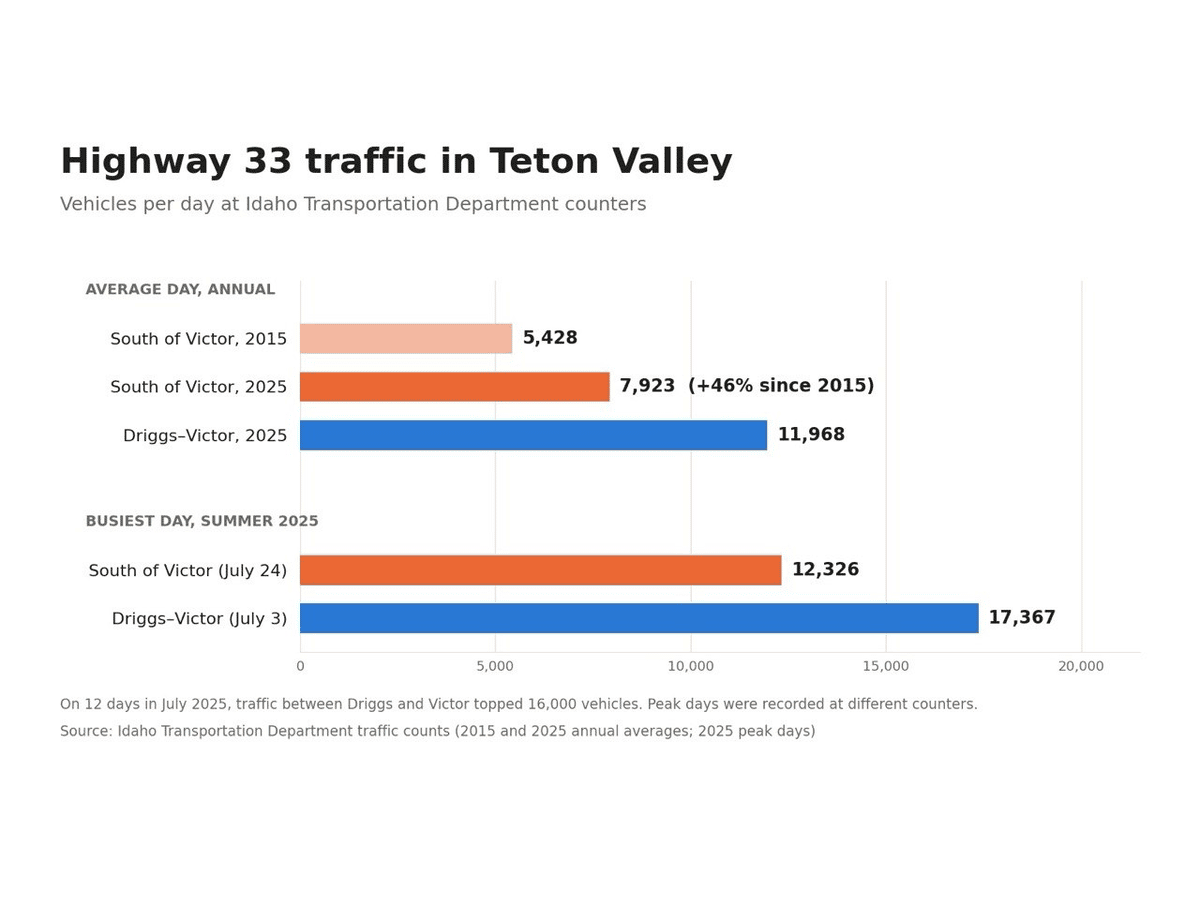
DRIGGS — Highway 33 between Driggs and Victor carried as many as 17,367 vehicles in a single day last summer, an Idaho Transportation Department (ITD) planner told Teton County commissioners June 22. The agency's highest-priority safety project on that stretch, turn lanes at the 6000 South intersection, was scheduled for 2031 and now has no construction money after the Legislature cut the department about $1 billion over seven years.
ITD District 6 planner Jeff Sneddon laid out the corridor's traffic counts from a 2025 analysis. Average daily traffic on Highway 33 between Driggs and Victor reached 11,968 vehicles across the full year, a figure that includes the winter off-season. On 12 days in July 2025, the daily count topped 16,000. South of Victor, traffic ran over 11,000 vehicles a day for 22 days. The single-day high, 17,367, came on July 3. Three automatic counters produce the numbers: one on Ski Hill Road, one about half a mile south of Darby Road, and one roughly three miles south of the Highway 31 junction.
The 6000 South intersection reached the top of ITD's turn-lane list after a fatality there, ITD District 6 engineering manager Brian Young told commissioners. It is one of several intersections on the highway the department has flagged for left- and right-turn lanes; 2000 South is next, and its design has started. At 6000 South, engineers found the Fox Creek box culvert too narrow and too old to leave in place, so ITD folded a culvert replacement into the project. That work touches the county road and the bike path and requires a survey the agency is contracting now.
Design continues. Construction money does not. District 6 engineer Jason Minsker said the Legislature cut ITD $165 million a year, about $1 billion over seven years, pushing projects across the state into an unfunded category. "We lost a third of construction," he said. The Valley Signal has reported on the same state cuts as they reached county and local road budgets. For Highway 33, the effect is that even the department's top-ranked intersection fix has no date attached.
The corridor study is further out still. ITD is preparing a request for proposals for a Highway 33 congestion and capacity study, hoping to hire a consultant by August and expecting 10 to 13 months of work after that. Sneddon said the first phase covers the highway from the Wyoming line to Highway 32, with a second plan to follow. A single intersection's turn lanes were a 2031 project before the cut; the wider rebuild is a longer horizon than that.
At the same meeting, commissioners added a smaller, local source of money for the 6000 South lanes. They approved the Golden Eagle Division II final plat in the Teton Reserve subdivision on the condition that the developer pay a proportionate share of the turn lanes and chip-seal 6000 South from Highway 33 to the subdivision entrance. Commissioner Dan Powers' motion set a $25,000 deposit within five business days, with the final figure calculated with county staff within 90 days and surety at 125 percent.
The turn lanes were already promised. Addendum C of the 2003 Teton Reserve development agreement states that a left-turn lane and a right-turn deceleration lane "are warranted" at Highway 33 and 6000 South, with the work due "prior to construction of 50 residences." Teton Reserve was platted in 2003 and has built out in phases since. County records show 42 houses now standing on more than 50 platted lots in its earlier phases, with the Golden Eagle plat set to add 26 more. The lanes were never built. Golden Eagle is a later phase of the development, and its current owner is not the developer that signed the 2003 agreement. The county's staff report for the June 22 plat listed five conditions and did not mention the turn lanes, and the developer's draft agreement did not carry them either. The requirement returned only after commissioners raised it during the hearing. The applicant's representative, Allison Ehlert, said the developer had no objection to paying a share, and the property's owner offered to put $25,000 in escrow that afternoon to avoid losing the construction season.
During the morning presentation, Commissioner Ron James questioned paying $300,000 to study where wildlife get hit while the 6000 South intersection went unfunded. "I can put you in my truck and show you where all the animal collisions are," he said. The board approved the study that afternoon anyway, contracting HDR for an SS4A wildlife-vehicle collision mitigation plan funded by $240,000 from the Federal Highway Administration against a $60,000 county match. James voted yes under protest, asking that the record show he found the spending "ridiculous." Wildlife collisions are a documented hazard on the corridor; a Rexburg man died in March after his truck struck an elk on Highway 33.
Public Works Director Darryl Johnson told the board the county had passed on a separate SS4A grant, one to build improvements an earlier county safety study had recommended, because the local share ran too high "right when our money was cut from the state." He planned to apply again at the next round.
What to watch: ITD will present its District 6 projects at a community board workshop August 19 at 1:30 p.m. in Idaho Falls. The agency expects to select its Highway 33 study consultant within the next couple of months. The Golden Eagle developer has until late September, 90 days from the June 22 vote, to settle the turn-lane figure with county staff.
Sources
- Teton County BOCC regular meeting, June 22, 2026 (morning and afternoon sessions)
- 2003 Teton Reserve Development Agreement, Addendum C (Teton County Inst. #153426)
- Teton County staff report, Golden Eagle Division II Final Plat, June 22, 2026
- Teton County agenda item 25371, SS4A Wildlife-Vehicle Collision Mitigation Plan contract award, June 22, 2026
- Teton County GIS parcel viewer
- Teton County Road Levy Returns to May Ballot as State Cuts Raise the Stakes
- Rexburg Man Killed in Highway 33 Rollover After Hitting Elk
Subscribe
The Morning Signal
Teton Valley news, once or twice a week. The reporting is airtight. The introduction is unhinged.