Victor Accepts the AJ Trail Easements 2-1, Without Attaching Any Conditions
Victor's council accepted the AJ Trail easements 2-1 and approved a maintenance agreement, attaching no conditions on e-bikes, enforcement or closures.
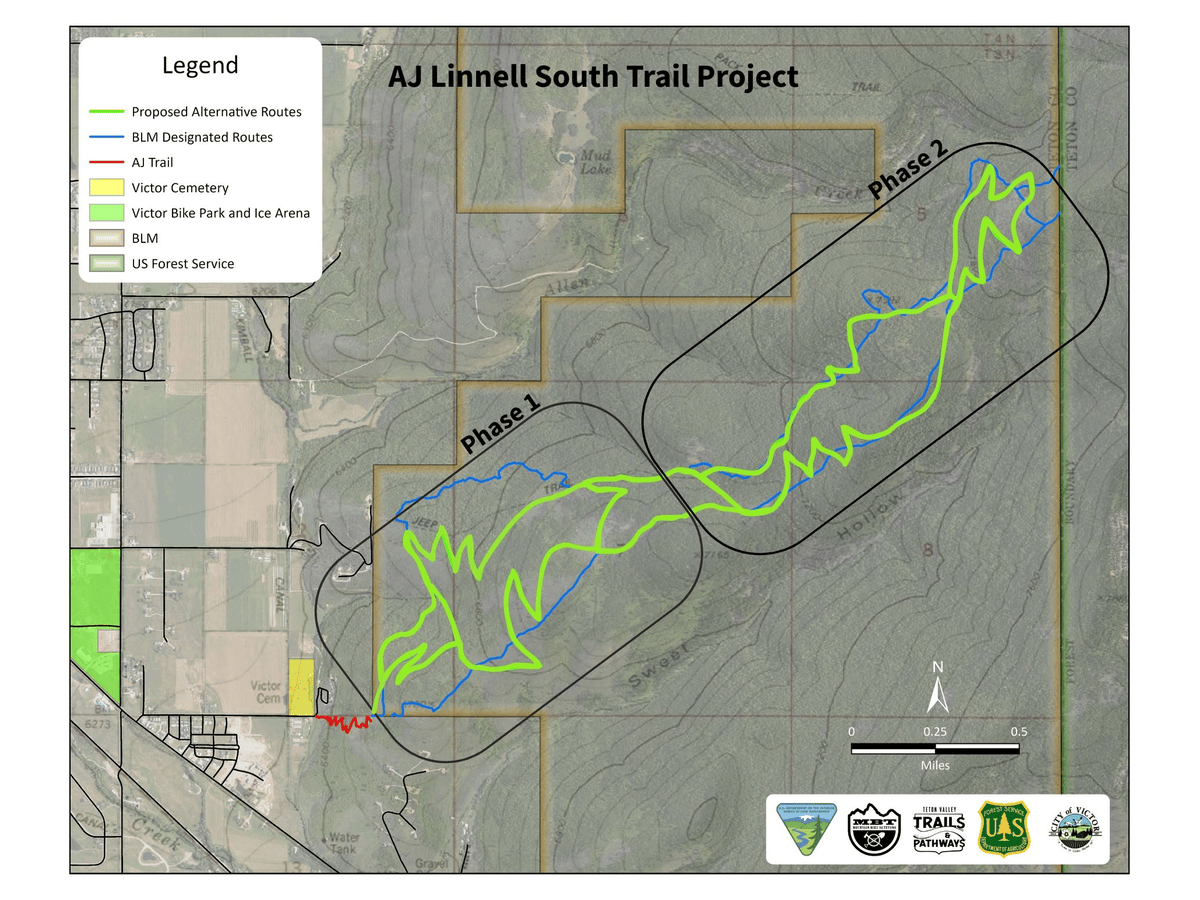
VICTOR — Victor's city council accepted the two AJ Trail easements that provide legal access to public land above town Wednesday night and approved a maintenance agreement with Mountain Bike the Tetons and Teton Valley Trails and Pathways, each by a 2-1 vote. The easements grant hikers and mountain bikers a route from Cemetery Road onto Bureau of Land Management ground, resolving a corner-crossing problem that has existed since volunteers built the AJ Linnell Trail in 2015.
Council member Emily Sustick made all three motions, and Stacy Hulsing seconded them. Amy Ross voted against each. Erica Linnell, whose late husband the trail is named for, abstained.
Mayor Sue Muncaster said the city had received "over 150 comments" on the item, "about 500 pages at last count."
Muncaster asked twice during deliberation whether anyone wanted to attach conditions to the approvals. "Are there concrete conditions? Is there anything that is within our authority that you would like to recommend?" No council member moved to attach any.
The easements explicitly disallow e-bikes. However, the BLM trails allow them, and the AJ Trail is the only legal access to the BLM land. Holly Bender, who granted one of the two easements, asked the council to "get to the bottom of the e-bike issue," which she called a conflict.
Before the meeting, Bender had written to the council with three questions. She asked how many miles the 2024 plan approved, how the BLM's route designations squared with the e-bike access the project has been marketed as offering, and whether Idaho Fish and Game had been given the chance to weigh in on ground she described as winter range and calving habitat for elk and mule deer. Those questions should be "answered, on the record, before the Council finalizes anything."
TVTAP has no authority to police the trail. Executive Director Dan Verbeek told the council, "We don't have enforcement capability. We have outreach and education opportunities," adding that his board asked for that point to be written into the agreement.
Matt Pieron, Fish and Game's regional supervisor, spoke before his agency's presentation to say it holds no authority over the trails in question. "We do not have regulatory authority over lands," he said. "That's why the partnerships that we have with land management agencies are so important." Pieron said some of what the council was about to hear "may seem slightly at odds with what you just heard from the BLM," and asked it not to read the two agencies that way, describing Fish and Game's role as supplying decision makers "one piece of the information, of many pieces of information." He added: "I respect that decision space, but we don't always agree."
Regional technical assistance manager Matt Proett then showed the council elk collar data covering the hillside above Victor. He described one study in which mountain biking "created a stronger response for elk fleeing from trails than either horseback riding or hiking," with elk fleeing "up to essentially half a mile." Proett told the council the literature on mountain biking is smaller than the literature on recreation generally, and that the study was not "indicative of all the studies that are out there."
Seasonal closures are administered by the agencies that manage the land, Fish and Game told the council, "which in our world is largely Forest Service and BLM." Its own role is technical assistance.
The Bureau of Land Management signed the travel management plan governing those routes in May 2024, after an environmental assessment under the National Environmental Policy Act. The plan concluded it "will result in a reduction in motorized access to sensitive wildlife habitat." Upper Snake Field Manager John Reffit told the council its "seasonal closures, time limits on construction, and route-specific mitigations were developed precisely to reduce impacts to wintering elk, moose, mule deer, and other wildlife."
"No additional NEPA is required to implement the TMP, which is already analyzed and decided," Reffit told the council. He gave a different answer on the network's later phases. "If at some point in the future a brand new proposal not yet analyzed were to come forward, such as extending the trail network to Fox Creek, then that new idea would trigger fresh NEPA review," he said. "But there's been no such proposal before the BLM today."
MBT Executive Director Chris Brule showed the council his group's four-phase map. The lines in the fourth phase "are conceptual," he said. "They're not finalized; they haven't been proposed to the BLM." The third phase is undeveloped Fox Creek access. Brule said the map's mileage differs from what the plan approved "because we estimated what that might be with reroutes."
Ross read aloud a passage she said someone had added internally to the council's materials for the item, stating that the BLM had determined a categorical exclusion was appropriate and that the decision was final. A categorical exclusion is a lighter level of review than the environmental assessment the agency ran. The posted agenda contains no such language. "I'm not sure where that information came from," Reffit said. "We're not using a CE, we're using an EA. And we've never proposed a CE."
Linnell took part in the questions and the deliberation before abstaining, which drew objections from two residents during public comment. Muncaster had said at the start of the item that the city attorney "found no legal conflict of interest" requiring Linnell to step aside, and that she would take part in questions and deliberation. "I wrote an email to everyone on this council and to staff saying I would recuse myself from voting, but that doesn't mean I wouldn't advocate for something I believe in," Linnell said. She had set out her planned recusal in August.
What to watch: The mayor is authorized to sign and record both AJ Trail easements. The maintenance agreement does not take effect until the boards of Mountain Bike the Tetons and Teton Valley Trails and Pathways and the city attorney approve a final version. Brule has said groundwork begins once the easements and a separate agreement with the BLM are in place.
Sources
- Victor City Council Sept. 23 agenda
- Victor City Council Sept. 23 public comment packet
- DOI Office of the Solicitor letter, Sept. 22, 2026
- Idaho Department of Fish and Game agenda report
- Victor City Council Aug. 12 staff report and packet
- BLM Upper Snake East Travel Management Plan
- AJ Trail Easements Return to Victor's Council Sept. 23, Without a Vote
- Victor Now Expects to Vote on the AJ Trail Easements Wednesday
- Joining Victor City Council, and Why I'll Recuse on the AJ Trail
Subscribe
The Morning Signal
Teton Valley news, once or twice a week. The reporting is airtight. The introduction is unhinged.