Fire Marshal Asks His Board to Stop Allowing Fire Ponds
Teton County's fire marshal asked his board to stop allowing fire ponds as the water supply for new subdivisions, a day after the county approved one.

·
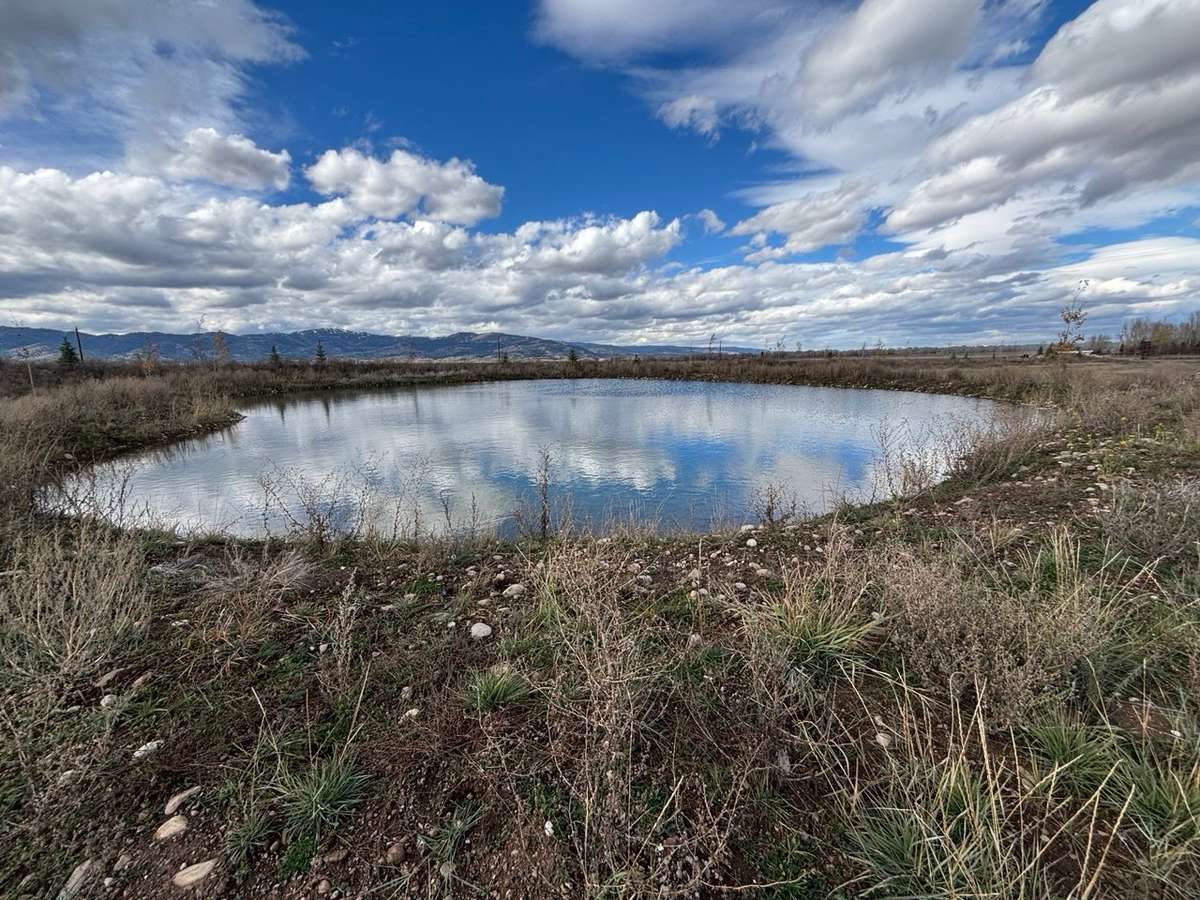
DRIGGS — Deputy Chief Kevin Brown asked Teton County Fire & Rescue's commissioners on Oct. 27 to stop allowing fire ponds as the fire-protection water supply for new subdivisions, and to sign the rewritten rules as soon as their next regular meeting.
Developers would pick instead among a cistern, a pressurized well with a hydrant, or a central water main. "Fire ponds now are paid for by the developer," said Brown, the district's fire marshal, and a cistern or a fire well would be a development cost the same way.
The International Fire Code, adopted as Idaho law, requires a water supply for any new building and speaks in terms of hydrants. A hydrant everywhere in the county was not feasible, Brown said, so the district long ago wrote a subdivision resolution that "takes the requirements of the fire code and kind of lowers them a bit. So it's more accessible for people." County planning, zoning and building staff told him the rules are "strictly in our purview," he said.
The county has about 170 fire ponds, built to different designs and in different states of repair. "If I gave you a list of ponds right now, if you went and drove and looked at 10 of them, 5 of them would be just mud and weeds," Brown said. They are supposed to be tested annually. "But we know that's not happening regularly," he said. The only lever the district holds is a building permit, and in a subdivision that is built out, or one sitting idle, years can pass without a permit and without a test. Drafting from a silted pond pulls mud into the engines, and ice and sediment cut into the volume the pond was designed to hold.
Chief Mike Maltaverne asked the commissioners to think about what a pond is for. "It's for fire suppression. So if a property catches fire, home, business, whatever, it provides water for us for firefighting," he said. The equipment differs from pond to pond, and the district does not carry a set for each one. "And so how do we then leave this fire station and go out really not knowing what we're going to get? ... it's just not providing good, predictable, effective water for firefighting." Over 30 years the supply has become "a little bit unpredictable and unreliable," he said, where underground water and cisterns are "a known commodity. We know it's going to be there and it's going to work when we get there."
"Just some back of napkin math that we did based on some good data for the area, we think fire ponds lose about 5 to 10 million gallons to evaporation a year in this county," Brown said. "And they all have autofill float valves from wells. So we're just pulling groundwater out to then evaporate it." He expects farmers and ranchers to take that to the state once they notice. Brown said there "does seem to be law on the books now that says fire ponds would have to have like a special permission" from the state because of the evaporation, and that "we're all a little bit concerned that they could pull that back at any time."
The rewrite would also tie the water requirements to the distance from each home instead of the lot size. The county's switch to average density in its Land Development Code, Brown said, "kind of killed that model."
Commissioner Bob Foster presided. Board chair Jason Letham was delayed and did not join the open session. "When you look at some of the subdivisions, like some of the new ones that are going out north by Tetonia, they're 35-acre lots," Foster said. "It's a long ways from where that fire pond might be."
Foster asked whether developers would be required to put a provision in their HOA agreements or bylaws making the fire system "a responsibility of the HOA" once "the subdivision is sold out and the developer moves on." "That's the way they're written down," Brown said. "And it says in all those agreements that they'll take care of the testing and certification. But it still can happen." Associations change leadership, Foster said, and argue over who pays for what.
"All current fire ponds would be grandfathered in," Brown said. "I do want to add in that if one of those fire ponds ever has to be completely rebuilt, like the liner has failed or doesn't hold water, or the piping is bad, that we would consider having them come up to current code and not allowing them to rebuild that fire pond." Hardship or a lot's specific conditions would be open to discussion, he said. The cutoff would be the day the board signs: "Anything that's in the process of getting the permit or has some type of conditional approval from us already, they're grandfathered in."
Foster's own subdivision was developed in 1978, when there was no fire-protection requirement of any kind. "We can't retroactively require, you know, homeowners to put something in," Brown said. Foster asked whether homeowners who wanted a system could build one to the new standard. They could, Brown said.
"Like everybody else, I just went through my struggle with my homeowner's insurance renewal," Foster said. "Virtually every company we talked to said we don't care what your water supply is. You're more than 5 miles from a fire station, so you get the highest rate." Brown said agents call the district daily now, and when the nearest water is a pond, "some insurance will say, no, I don't mean a fire pond. I mean, where's your nearest hydrant?"
"We're not on the cutting edge of this," Brown said. "Jackson determined several years ago they weren't gonna allow it anymore. Sun Valley, same thing." Teton County, Wyoming's 2021 resolution for new subdivisions says open water ponds are not permitted for fire department water supply, and tiers the alternatives by lot count and density. Brown's Idaho example is countywide: Blaine County's 2021 fire code, not a Sun Valley ordinance, bars both building a pond and drafting from open water for fire department use, and offers a 10,000-gallon cistern instead.
The board took no vote. "You don't need to vote today, but keep it in mind," Brown said, and asked the commissioners to consider signing an attorney-reviewed version "maybe as early as the next meeting." He wants it "signed and enacted in pretty short order." He said he had raised the changes with a lawyer, who was going to look into whether they run afoul of state law, and that county Planning Administrator Joshua Chase has spent the past six months telling developers the change was coming.
Teton County commissioners had approved the preliminary plat for Zamora Estates a day earlier, on Oct. 26: four 2.5-acre lots on 10.22 acres at State Highway 33 and N 3500 W, in the Tetonia area of impact, for owner Raymundo Zamora Zanabria. Its water supply is a fire pond.
Brown had gone through the pond's improvement plans six days before that vote. "Can you walk me through how you got the effective volume of 132,400 gallons?" he wrote to project engineer Nick Mestre on Oct. 20. "It doesn't look quite right to me. With the 3:1 side slopes, most of the water is up near the top of the pond, and when I run it I come up well short of 120,000 gallons in the bottom 5 feet." The plans accounted for ice but not silt, he wrote, and the strainer sat almost on the bottom, where it "will get buried pretty quick." He also questioned the two-foot ice deck and said the water in the dry hydrant's pipe would sit a foot or two below the ground and freeze.
In the same email thread, on Jan. 30, Brown had written that "the fire district would allow a fire pond for this 4 lot subdivision."
Presenting the plat, Mestre asked the commissioners to condition their approval on the fire marshal's sign-off. "The fire pond, it was really due to a timing mix-up. I just got the review back from the fire marshal about a week ago," he said. "The changes he requested are technical in nature, just to the pond. Nothing you'd notice on the plat or could see from afar. Minor increases to the volume, getting the pipe inlet off the bottom for silt." The commissioners attached that condition, along with a road-maintenance agreement before final plat and a scenic-corridor application with each building permit.
The county planning commission had recommended approval 7 to 0 on Sept. 8 and asked that the pond be moved as far from Highway 33 as possible, a condition drawn from the project's wildlife habitat assessment. The staff report for the Oct. 26 hearing marked that recommendation addressed, citing a consultant's letter that the pond would not draw ungulates because the site offers them no cover. Relocation was not among the three conditions the commissioners adopted.
Under the rules Brown brought to his board the next day, Zamora Estates would be grandfathered.
The resolution the board would be signing is not public. It does not appear on the district's website, and the two handouts Brown gave the commissioners (a list of the changes he wants, and a sheet on split subdivisions and the proposed water rules) were not in the meeting packet.
What to watch: the board's next regular meeting. No date for a signature was set on Oct. 27.
Free newsletter
The Morning Signal
Teton Valley news, once or twice a week. The reporting is airtight. The introduction is unhinged.
Free. Unsubscribe anytime.
Sources for this story
- Teton County Fire & Rescue board meeting, Oct. 27, 2026
- Zamora Estates staff report
- Brown-Mestre email thread on the Zamora fire pond
- Zamora Estates improvement plans
- Teton County commissioners agenda, Oct. 26, 2026
- Teton County, Wyoming Fire Protection Resolution for New Subdivisions, 2021
- Blaine County Ordinance 2021-06, fire code
- Teton County Fire & Rescue fire protection and insurance information
- Teton County Commissioners Monday: The Midway Substation, Two Subdivisions, and a Budget Opening