What Keeley and Wolfe Said at the District 1 Forum
Kim Keeley and Brad Wolfe, running for Teton County's District 1 commission seat, answered student debaters' questions on growth, wildlife, housing and ICE.
·
Results, Nov. 4: Keeley defeated Wolfe for the District 1 seat, 3,792 to 2,330, in unofficial results. Full unofficial results
DRIGGS — Teton County Clerk Kim Keeley and Commissioner Brad Wolfe, who are running for the District 1 seat, answered questions from Teton High School debaters Wednesday on housing, wildlife, growth, the county's next comprehensive plan and immigration enforcement. They differed most over the county's wildlife overlay, which Wolfe said is too large and Keeley would leave as it is.
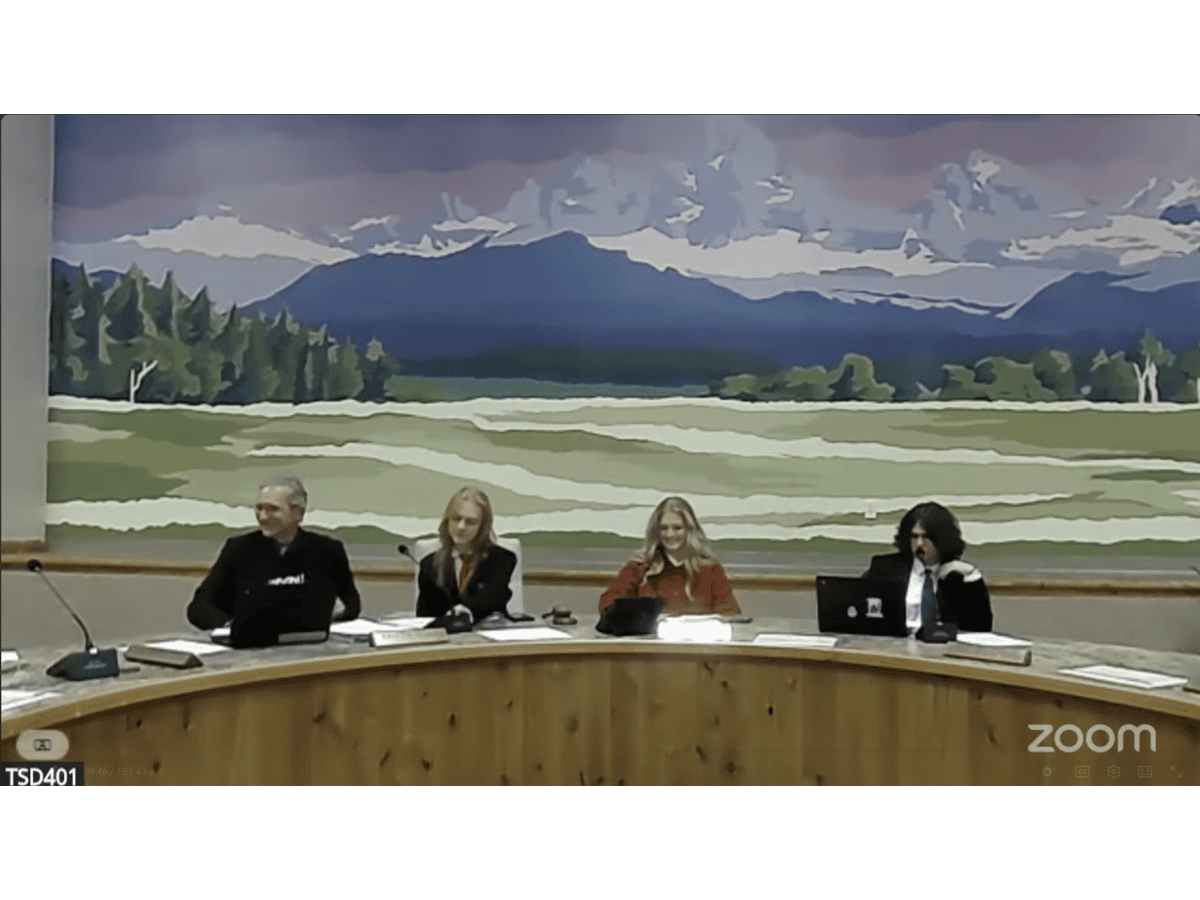
The school's speech and debate team hosted the two candidates at the high school, and Teton School District 401 streamed the forum on its YouTube channel. Tetonia Mayor Brent Schindler, who teaches at Teton High and coaches the team, moderated. Students wrote the first questions and gave them to the candidates that morning, and the rest came by email and on cards from the audience. A coin flip decided that Wolfe would answer first.
District 1 is the only contested county commission race on the Nov. 3 ballot, a four-year term. Wolfe, the board's chairman, is the Republican. Keeley, clerk for eight years and a co-owner of the Emporium in Victor from 2000 until she sold it last year, is the Democrat.
Wolfe opened by calling Keeley "anything but opponent. We sit together every two weeks, and we're good friends."
The comprehensive plan
The county is about to rewrite its comprehensive plan, which guides zoning and land-use decisions. Asked how he would lead that process, Wolfe said, "We've set aside $300,000 to work on the comprehensive plan. In the next year or so, I don't think we need to do that. My idea is to gather the public together and get the information from them. And you may not like this, but I'd like to take all that information, put it into AI, and spit out a comprehensive plan, and then go through that and scrutinize it. That's exactly what we're going to pay someone $300,000 to do. So I think we can use that $300,000 a lot more effectively on other things." The audience applauded.
Keeley has sat in on early meetings with county staff about how to run the rewrite, and doubted it would cost $300,000. The outreach is another matter. "Tapping them to do the community outreach is unrealistic," she said of the staff. She said the county Planning and Zoning Commission had heard a proposal the night before to have staff run the outreach and a consultant gather the results "and then throw it into AI," and "thought that was a bad idea." At that Oct. 27 work session, one planning commissioner said putting "the burden of drafting this plan on staff, I think, is not the way to go." AI came up once, when Planning Administrator Joshua Chase told the commission that the county board "has had different opinions about staff capacity leveraging AI to do a lot of drafting."
Wildlife and development review
Asked how they would weigh the environmental effects of a subdivision, Wolfe said he "would start with a clear code, not opinions." He would have the county flag only its most sensitive ground, such as rivers, wetlands, foothills and steep slopes, where it now flags "huge chunks of land." Keeley said the county looks at a 10-lot subdivision, then a 20-lot one next door a month later, "and we evaluate it separately and don't take into account the impact of the 2 subdivisions right next to each other in a sensitive hillside zone." She would revive the county's wildlife and waterways committees to study cumulative effects, including on groundwater from clustered wells and septic systems.
The overlay came up directly when the audience asked what each had done or would do for open space and habitat. "Personally, I think our wildlife overlay is way too big," Wolfe said. "I'm not so sure that every single house should have to do a wildlife study, but definitely subdivisions."
"What I would like to do is not shrink down the wildlife overlay," Keeley said. "If we shrink the wildlife overlay, we are going to continue to constrain the wildlife into smaller areas and create more human conflict." She pointed to a 15-home hillside development on the west side of the valley, in a drainage nicknamed "the game funnel." Her description matches the Gallery Subdivision, 15 lots on 160 acres of foothills west of Victor, which commissioners heard Oct. 26 and continued to Nov. 9.
Keeley said the current board "doesn't love plans or studies," and that one of its first moves was an attempt to take apart the two advisory committees. Wolfe answered that the board would "rather spend money on getting the job done than doing a study." A wildlife crossing over a highway costs $1 million to $2 million, he said, and $300,000 in grant money won't pay for one.
Housing and sewer
Both steered away from the term "affordable housing." Wolfe spoke of "more affordable housing, or less costly housing," and Keeley of "housing affordability." Wolfe proposed a revolving fund, built from grants, donations and developer contributions, to help buyers with down payments, and a monthly stipend for sheriff's deputies who commute from outside the county to live in it.
Keeley opposed an idea she said has been "tossed around" to rezone the county's five-acre residential land to two and a half acres. "That's not going to create any affordable housing," she said. "It's just going to dig us deeper into our infrastructure mess because development in the unincorporated county is not paying for itself."
On sewer capacity, Keeley's understanding is that Driggs won't offer hookups in the unincorporated county for the next 10 years. "I don't think we should be focusing growth on the hopes of someday hooking up to a sewer line that may or may not exist," she said. Wolfe would start planning now for a countywide sewer system: "There are people who will come in and build that sewer system at their own cost and take care of it." He added, "You can't have septic systems on 1-acre lots or quarter-acre lots."
The economic plan
Asked about the valley's 2024 economic development plan, Wolfe listed the county's completed work: an agricultural protection area, a historic preservation commission, the C-PACE financing program for energy-efficient building, and voters' approval of a recreation district.
Keeley said "almost all" of them were started by the prior board, and that this is the first year the county has not funded the Teton Regional Economic Coalition, which led the plan. "We're currently rolling back regulations on growth and making it less sustainable," she said. Wolfe answered later that "it's not that we didn't fund TREC, it's that there wasn't a lot of money," and that the county will pay the coalition for specific work instead.
Immigration enforcement
Students asked how the county's probation office works with federal immigration agents, citing reports of ICE arrests after required probation appointments. Wolfe read a prepared answer. Probation staff "does not detain, isolate, or hold individuals on behalf of federal authorities," it said, and federal agents carried out the detentions. County staff confirm identifiers like name and address to any agency that asks, from the Idaho State Police to ICE, and "Teton County does not maintain a written policy" for probation's dealings with ICE. Wolfe said a policy is now under legal review.
Keeley said she has little say over probation as clerk, but "as a citizen of the community, have been very appalled by what's been going on." She said Wolfe's answer had been written by the county administrator. When the next question came to him, Wolfe confirmed it, saying the administrator wrote it at his request and that, with no policy in place, "we had to say something." He credited Commissioner Dan Powers with starting the push for one.
Students also asked about the 287(g) program, under which local officers take on federal immigration duties. Keeley thought the decision was the sheriff's, "although I'm not 100% sure on that," and Wolfe interjected, "I think you're right." Speaking "as a human," she said she would oppose it. She drew a line at noncitizens who commit a serious crime, who she said should not be allowed to stay. People on probation "doing all the things that they are supposed to be doing" are different: "I don't support going after them, so I think that's just where I'll leave it." The audience applauded. Wolfe's answer: "No. That's my answer." The decision is the sheriff's, he said: "We can't dictate to the sheriff's office what their policies are. That's their decision. However, we do control their budget."
Where they agreed
Both support a family land division in concept and said the version before the board needs work. Both want relief from Idaho's 3% cap on property tax budget growth. Keeley, who has pressed the issue through the Idaho Association of Counties, said the county's base was set when it was "more of an ag community." Wolfe called the cap "not fair" and said "3% does not pay our COLA every year."
Wolfe raised the matter of his vacation home himself when the students asked whether each would be available in person. He said he puts 40 hours a week into the job and proposed that one commissioner be at the county building one day each week. Keeley said she has put her cell number on her website and answers it.
In his closing, Wolfe answered talk that he had taken his name off the ballot: "I never did that, but I did consider it deeply." He said he will serve the full four-year term.
After the candidates were excused, Superintendent Brian Ashton took questions on the district's supplemental levy, which is also on the ballot.
What to watch: Polls are open from 8 a.m. to 8 p.m. on Tuesday, Nov. 3. On Nov. 9, commissioners take up the Gallery Subdivision and the family land division ordinance again.
Free newsletter
The Morning Signal
Teton Valley news, once or twice a week. The reporting is airtight. The introduction is unhinged.
Free. Unsubscribe anytime.
Sources for this story
- District 1 commissioner forum, Oct. 28, 2026 (Teton School District 401)
- Teton County sample general-election ballot, Nov. 3, 2026
- Teton County voter guide: every race on the Nov. 3 ballot
- Teton 401 asks for $7.09 million a year after the state cut its levy
- Teton County commissioners Monday: the Midway substation, two subdivisions and a budget opening
- Family land division loses its density limit, then its vote