An Active Fire Season Is Coming to Teton Valley
Federal forecasters expect an above-normal fire season in southern Idaho this July. Where the Caribou-Targhee spring burns stand and how to prepare.
DRIGGS — Federal forecasters expect an above-normal fire season across southern Idaho this July. Snowpack across most of the West is at or near record lows after a record-warm mid-March. Spring snow and rain since have driven a fast green-up that's complicating the prescribed burns the Caribou-Targhee National Forest planned to run this spring.
"We're in a snow drought," Teton Basin District Ranger Jay Pence said in an interview. "Heavy fuels and 1,000-hour fuels are usually not able to burn this early in the spring, so everything is shaping up towards an active fire season."
That assessment lines up with the National Interagency Coordination Center's April outlook, which forecasts above-normal significant fire potential across southern Idaho, most of Utah, and eastern Nevada in July. More than 56 percent of the country is now in drought, and snow across much of the West melted out earlier than usual after the mid-March heat wave.
Where the spring burns stand
The Caribou-Targhee announced 1,185 acres of spring 2026 prescribed burns in Teton Valley in mid-March.
Pile burning began this week at Grove Creek, on the South Valley Boundary along the forest edge near the Grove Creek Subdivision north of Pine Creek Pass. At Mike Harris, three miles south of Victor, crews are working through piles left over from past years' cuts: fuel that was stacked and cured but never burned. The 800-acre Hill Creek unit, five miles southeast of Driggs, is on the books but unlikely to burn this spring. "We want to but doubtful depending on weather, due to all the green-up that happened," Pence said.
The Red Creek project, the largest fuel treatment effort in the Big Holes, has no spring 2026 burns scheduled. Pence said the district is planning Red Creek burns for the fall, with multiple candidate units totaling 100 to 800 acres possible.
The same dry conditions driving the elevated July outlook are also keeping prescribed burns from doing the fuel-reduction work they're meant to do. Heavy fuels won't carry fire under the cool, moist windows crews need to keep prescribed burns controlled.
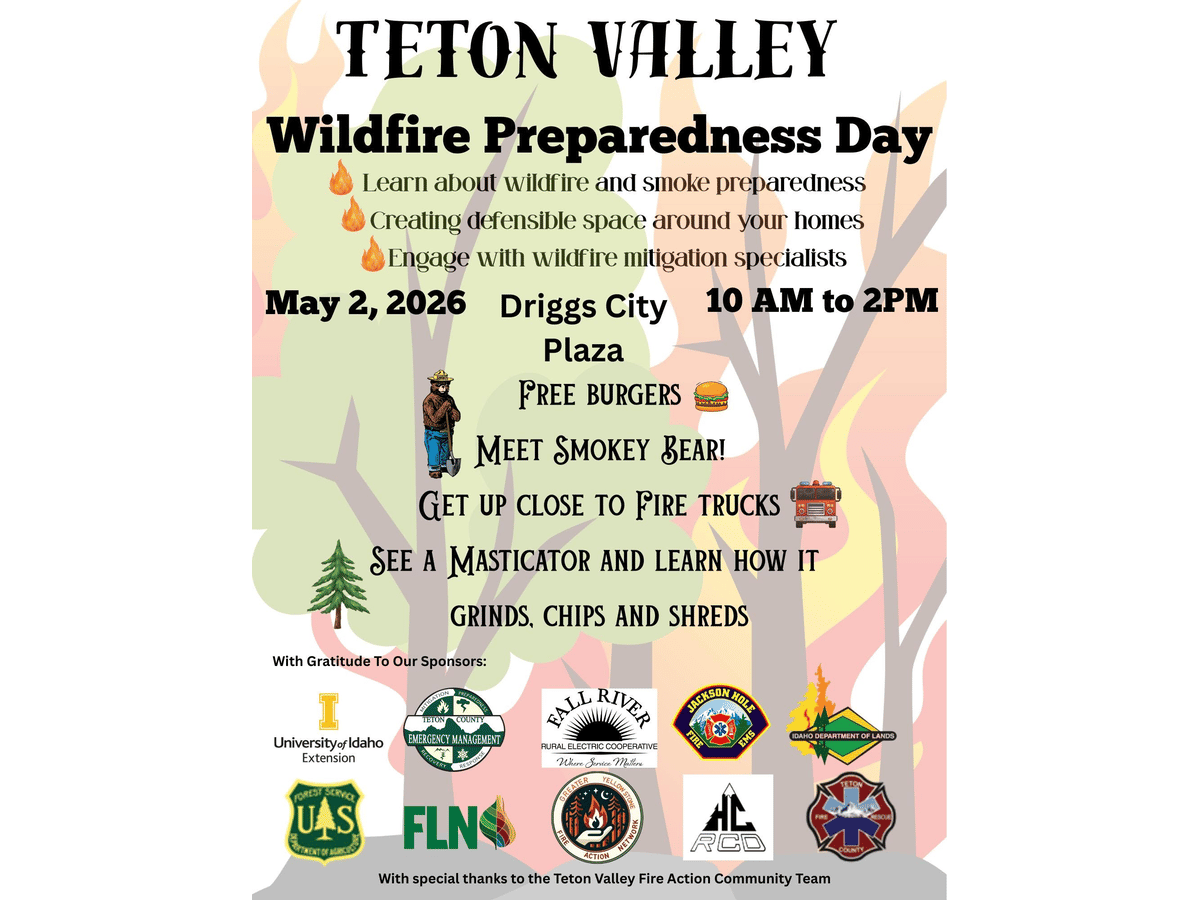
Wildfire Awareness Day, May 2
Teton County Fire & Rescue and partner agencies will host Wildfire Awareness Day on Saturday, May 2, from 10 a.m. to 2 p.m. at Driggs City Center. Residents can talk with firefighters, foresters, and conservation district staff about home risk and mitigation options before the season ramps up.
Property owners in the wildland-urban interface can take three steps regardless of acreage or which agency oversees nearby land:
Get a free site visit. The Teton Conservation District offers wildfire risk assessments for private property at no cost.
Apply for fuel reduction funding. The Teton Conservation District's matching grant program offers up to $3,000 covering 50 percent of vegetation management costs, with no acreage minimum. Larger parcels of five acres or more may also qualify for federal NRCS cost-share through the Joint Chiefs' Landscape Restoration Partnership.
Manage defensible space. Clear vegetation within 30 feet of structures. Remove dead trees, trim branches to six feet above ground, and keep woodpiles at least 30 feet from buildings.
Who responds to what
On national forest land, the Caribou-Targhee leads the response and pulls in regional and national resources as needed. Teton County Fire & Rescue handles fires on private land and in the wildland-urban interface, and may join initial attack on federal incidents.
TCFR received a $5,000 Competitive Grant from the Community Foundation of Teton Valley for wildfire risk modeling, part of $85,000 awarded across 17 local nonprofits in the foundation's 2026 round announced April 17.
TCFR is also fundraising toward its first Wildfire Mitigation Coordinator position, with a fall 2026 hiring target. A community group running the campaign through tvwildfiremitigation.org is raising $160,000 to bridge-fund the position and buy wildfire modeling software. Donations flow through the Community Foundation of Teton Valley's Wildfire Mitigation Fund. The coordinator will run TVFACT, the multi-agency Teton Valley Fire Action Community Team, and lead homeowner outreach across the valley ahead of the 2027 fire season.
What to watch: Whether the spring window stays open long enough to complete Hill Creek's 800 acres. The fall Red Creek schedule and how much of the planned 100–800 acres burns. Stage 1 fire restriction announcement on the Caribou-Targhee. Updated NICC outlooks through May, June, and July.
Sources
- National Interagency Coordination Center, April 2026 Monthly Seasonal Outlook — above-normal fire potential forecast for southern Idaho in July; drought and El Niño context.
- Caribou-Targhee National Forest spring 2026 prescribed fire announcement — 1,185 acres planned in Teton Valley; unit list (Grove Creek/South Valley Boundary, Mike Harris, Hill Creek).
- U.S. Department of the Interior — Behind the Scenes: Who is Responsible for Wildfire Management in the U.S.? — federal/state/local jurisdictional framework.
- Community Foundation of Teton Valley — 2026 Competitive Grant Awards — $5,000 wildfire risk modeling grant to TCFR, announced April 17, 2026.
- Teton Valley Wildfire Mitigation — $160,000 community fundraising campaign for the TCFR Wildfire Mitigation Coordinator position and TVFACT operations.
- Teton Conservation District — free site visits and matching grant program (up to $3,000 / 50 percent cost-share, no acreage minimum).
- NFPA — Preparing Homes for Wildfire — defensible-space guidance.
Subscribe
The Morning Signal
Teton Valley news, once or twice a week. The reporting is airtight. The introduction is unhinged.