Teton County Adopts Drive-In Theater Code, Clearing LDC Path for Spud Rebuild
Teton County commissioners adopted a drive-in theater code on April 27, opening a permitting path for the long-stalled Spud Drive-In rebuild on Highway 33.
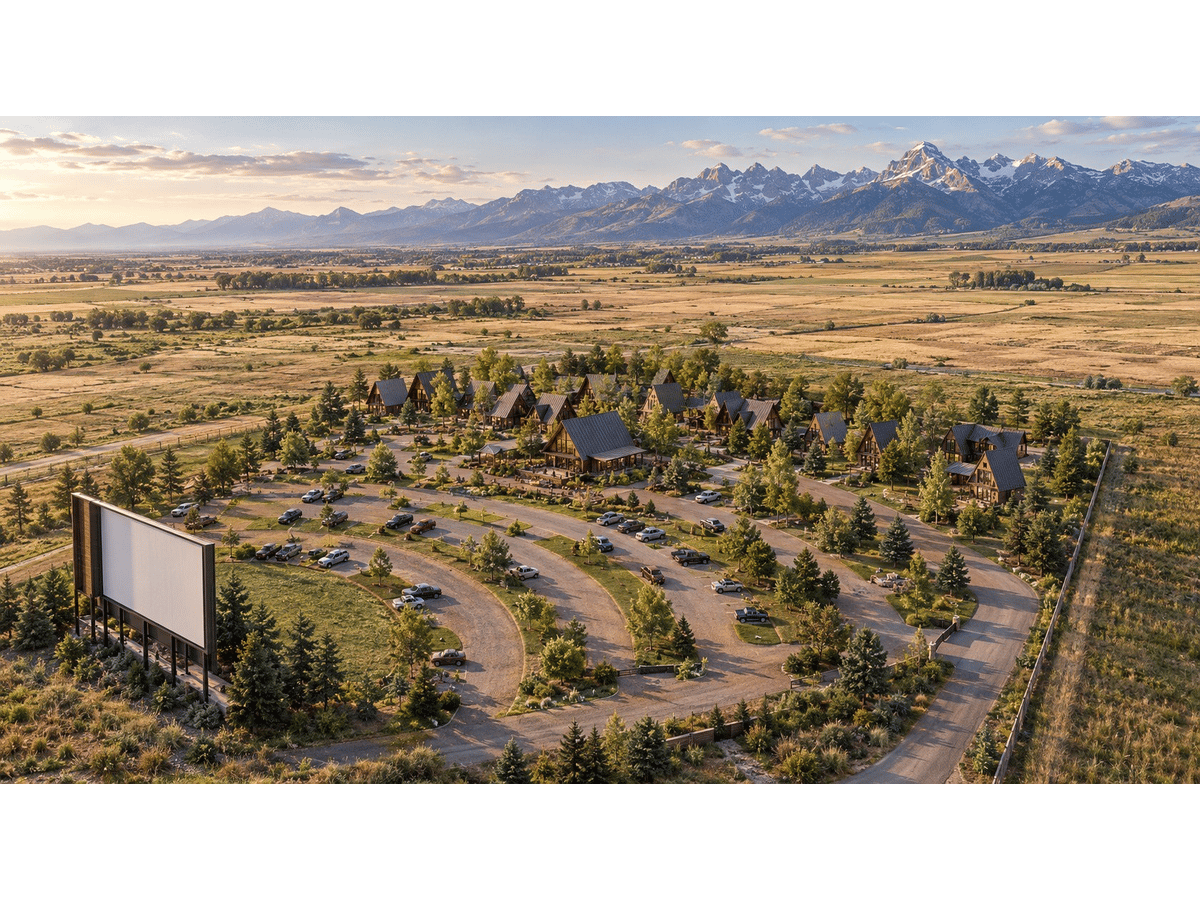
DRIGGS — Teton County commissioners voted 3-0 Monday to adopt Ordinance No. 2026-04-27, creating a "Drive-In Theater" land use category in the county's Land Development Code (LDC) and giving the long-stalled rebuild of the Spud Drive-In Theatre a clear regulatory path forward.
Commissioner Dan Powers made the motion to adopt. Commissioner Brad Wolfe seconded. Commissioner Ron James joined them in the unanimous vote.
The ordinance closes a process that began with a pre-application conference on November 21, 2025 and ran through a Teton County Planning and Zoning Commission (PZC) hearing on February 10, a Teton County Board of Commissioners (BOCC) public hearing on March 9, and Monday's adoption. The applicant, MD Spud LLC, is led by part-owner Tom Hedges as redevelopment manager, with Jennifer Zung of Harmony Design and Engineering serving as agent.
A 2022 windstorm and a grandfathering problem
The Spud, which opened along Highway 33 in 1953, lost its movie screen in a 2022 windstorm. Rebuilding has been stalled since. The property sits on a non-conforming, grandfathered parcel, meaning it predates the current LDC and does not comply with it. The rights afforded to non-conforming uses are, the staff report says, restrictive and ill-defined.
The applicant argued that this legal ambiguity prevented investment despite community support and a rebuild budget. Monday's amendment resolves the question at the code level rather than the site level, by adding drive-in theaters as a recognized use in the LDC's use table and opening a permitting path that does not depend on grandfathering.
What the ordinance does
The ordinance amends LDC Section 3-2-2 to add Drive-In Theater to the use table as a Special Use in the Rural Neighborhood 5 (R-N 5) and Industrial Research (IR) zones, and enacts a new Section 3-6-7 establishing the use's definition and development standards.
Key standards adopted Monday:
- Minimum lot size of three acres.
- Required connection to a public wastewater treatment facility.
- Screen tower setback of at least 75 feet from any street right-of-way, with a maximum height of 60 feet in any zoning district.
- Screen orientation away from the primary public right-of-way.
- Hours of operation to be set during the Special Use Permit (SUP) review.
- Lighting off when the facility is not in active use.
- Amplified sound systems designed to minimize off-site noise (no specific decibel limit).
- Perimeter fencing required.
- Buffering and screening for adjacent residential or lower-intensity parcels, determined through the SUP.
The ordinance also waives several otherwise-applicable LDC provisions for drive-ins. Parking lot landscaping, lighting, buffer, and driveway access standards do not apply. There is no cap on parking lot size or lot coverage. In the ordinance's language, "the Scenic Corridor overlay development standards and review process are not applicable," a carve-out, since Highway 33 is one of the state highways governed by the county's Scenic Corridor regulations within 500 feet of the right-of-way.
A digital marquee on the back of the screen tower is permitted, with the planning administrator authorized to approve sign dimensions exceeding standard limits.
Changes from the earlier draft
Monday's ordinance reflects modifications the PZC recommended at its February 10 hearing. Drive-in theaters now require an SUP, which includes a public hearing, rather than the Limited Use Permit with administrative review the original application proposed.
Hours of operation, written into the original application as 8 a.m. to 2 a.m., are now set case-by-case through the SUP review. The PZC added buffering for adjacent properties as a new requirement. The PZC also revised the original language permitting use of the facility as a "special event facility" without additional permitting, routing those parameters through the SUP.
Concerns flagged in the staff analysis
The staff report identified three review criteria where commissioners were asked to deliberate before adopting.
On whether the amendment benefits the county as a whole rather than one landowner, a requirement under §4-4-F of the LDC, staff acknowledged the question was hard to answer with certainty. The proposal would benefit the Spud's owners, staff wrote, while arguing the standards were drafted to apply elsewhere if another applicant ever emerged.
On the LDC's broader purpose of protecting public health, safety, and welfare, staff noted that previous events at the Spud outside of film showings had raised questions, without specifying which events.
On potential impacts to existing development patterns, the staff report records the PZC's concern that the new use category could be used in the future to operate what amounts to a special event facility "under the guise of a drive-in theater," notwithstanding the ordinance's "bona fide" language.
Staff received no written public comment ahead of Monday's hearing.
What to watch
With Ordinance 2026-04-27 adopted, MD Spud LLC's next step is to submit an SUP application for the rebuild. That application will require its own public hearings before both the PZC and the BOCC, with operating hours, special event parameters, and buffering for adjacent uses set as conditions of approval.
The ordinance takes effect upon passage, approval, and publication according to Idaho law.
Sources
- Teton County Ordinance No. 2026-04-27 (draft) — full ordinance text, use table amendment, and §3-6-7 standards
- Staff Report for Drive-in Theater Code Amendment Proposal, BoCC 04-27-26 — review process, §4-4-F analysis, PZC motion, applicant identity
- Teton County BOCC meeting, April 27, 2026 — vote tally and motion sequence
Subscribe
The Morning Signal
Teton Valley news, once or twice a week. The reporting is airtight. The introduction is unhinged.